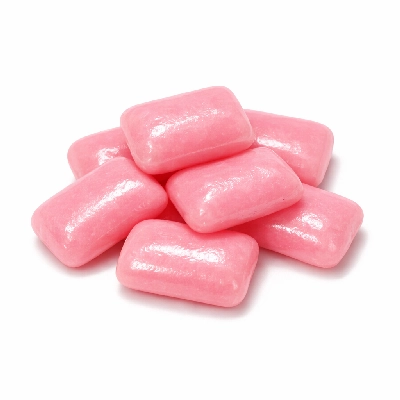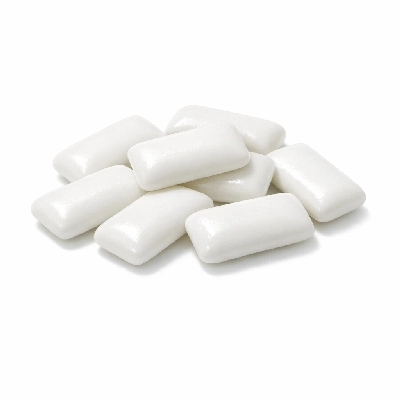
Chewing Gum Sugarless
Source of Calories
Nutrition Facts
| Nutrient | Amount | % Daily Value |
|---|---|---|
| Total Carbohydrates | 1.9 g | 1% |
| Net Carbohydrates | 1.85 g | 1% |
| Sugars | 0 g | 0% |
| Added Sugars | No data | - |
| Dietary Fiber | 0.05 g | 0% |
| Protein | 0 g | 0% |
| Total Fat | 0.01 g | 0% |
| Saturated Fat | 0 g | 0% |
| Monounsaturated Fat | 0 g | - |
| Polyunsaturated Fat | 0 g | - |
| Trans Fat | No data | - |
| Cholesterol | 0 mg | 0% |
| Vitamins | ||
| Vitamin A | 0 mcg | 0% |
| Vitamin C | 0 mg | 0% |
| Vitamin D | 0 mcg | 0% |
| Minerals | ||
| Sodium | 0.14 mg | 0% |
| Potassium | 0 mg | 0% |
| Calcium | 0.4 mg | 0% |
| Magnesium | 0 mg | 0% |
| Iron | 0 mg | 0% |
| Zinc | 0 mg | 0% |
% DV refers to how much a single serving of an individually packaged food or supplement contributes nutritionally to your daily diet, based on a 2,000-calorie-a-day diet. Generally, having 5% DV or less of a nutrient per serving is considered low, and 20% DV or more of a nutrient per serving is considered high.
Fat Composition
The suggested total fat consumption should be limited to 30% of total energy intake or less. The type of fat consumed should primarily be unsaturated fatty acids, with no more than 10% of total energy intake coming from saturated fatty acids (about 200 calories on a 2000-calorie diet) and no more than 1% of total energy intake coming from trans-fatty acids.
Vitamin Coverage
Vitamin A
0%
Vitamin C
0%
Vitamin D
0%
Vitamin E
0%
Vitamin K
0%
Vitamin B1
0%
Vitamin B2
0%
Vitamin B3
0%
Vitamin B5
-
Vitamin B6
0%
Vitamin B7
-
Vitamin B9
0%
Vitamin B12
0%
There are 13 essential vitamins required for the body to work properly, which are categorised into two categories: fat-soluble and water-soluble vitamins. Vitamins have a Recommended Dietary Allowance (RDA), provided by the Dietary Reference Intakes (DRIs), which vary by age and sex. The %DV indicates how much one serving contributes to the average recommended daily intake.
Mineral Coverage
Calcium
0%
Iron
0%
Magnesium
0%
Phosphorus
0%
Potassium
0%
Sodium
0%
Zinc
0%
Copper
0%
Manganese
-
Selenium
0%
Minerals are micronutrients, of which 13 of them are essential to the human body. The Recommended Dietary Allowance includes Calcium (1,300 mg/d), Phosphorus (1,250 mg/d), Potassium (4,700 mg/d), Sodium (2,300 mg/d), Chloride (1,500 mg/d), Magnesium (420 mg/d), Iron (18 mg/d), Zinc (11 mg/d), Copper (0.9 mg/d), Selenium (55 mcg/d), Molybdenum (45 mcg/d), Manganese (2.3 mg/d) and Iodine (150 mcg/d).
The data provided by eato.health is for informational purposes only and should not be considered medical advice. Please consult your physician before beginning any diet or nutrition plan.
About
How Long to Burn Off 5 Calories?
*Based on this person: 25-year-old female, 5'7", 144 lbs

Swimming
< 1 min

Jogging
< 1 min

Cycling
< 1 min

Walking
2 min
The data provided by eato.health is for informational purposes only and should not be considered medical advice. Please consult your physician before beginning any diet or nutrition plan.
📚 Health Research & Evidence About This Food
Sugarless chewing gum significantly reduces the incidence of dental caries by reducing harmful bacteria like Streptococcus mutans, a benefit supported by research in Nature and PubMed. Its sugar alcohols, such as xylitol, offer lower calories and carbohydrates, potentially aiding weight and blood sugar management. However, consuming these sugar alcohols may lead to gastrointestinal issues, and Harvard Health notes observational evidence linking high xylitol levels to an increased risk of heart attack or stroke.
1. Should Dentists Recommend Sugar-Free Chewing Gum to Help Prevent Decay?
Source: Nature, 2021
Summary: Sugarless chewing gum has been shown in a systematic review and meta-analysis to have a significant, though tentative, effect in reducing the incidence of dental caries compared to non-use or other sugar-free alternatives.
Read More: https://www.nature.com/articles/s41407-020-0493-8
2. Do Sugar-Free Candy and Gum Give You Gas? Researchers Think They Know Why
Source: ScienceDaily, 2026
Summary: Sugarless chewing gum, containing sorbitol, may contribute to sorbitol intolerance due to changes in gut microbiome, specifically a reduction in Clostridia microbes following antibiotic use and a high-fat diet, as observed in mouse studies.
Read More: https://www.sciencedaily.com/releases/2024/02/240215113723.htm
3. Xylitol: What to Know About This Popular Sugar Substitute - Harvard Health
Source: Harvard Health, 2024
Summary: Sugarless chewing gum often contains xylitol, a sugar alcohol that offers benefits such as lower calories, no blood sugar spikes, and improved dental health by reducing oral bacteria, though it can cause gastrointestinal issues in high amounts and is highly toxic to dogs.
4. Caries Preventive Effect of Sugar-Substituted Chewing Gum.
Source: PubMed
Summary: Sugarless chewing gum was the subject of a 3-year community intervention trial designed to determine its caries preventive effect among Lithuanian schoolchildren and to assess compliance with usage instructions.
Read More: https://pubmed.ncbi.nlm.nih.gov/11515642/
5. A Systematic Review and Meta-Analysis of the Role of Sugar-Free Chewing Gum on Streptococcus Mutans.
Source: PubMed
Summary: Sugarless chewing gum is the subject of a systematic review and meta-analysis investigating its role in influencing *Streptococcus mutans*, a bacterium targeted by preventive strategies to reduce the global burden of caries.
Read More: https://pubmed.ncbi.nlm.nih.gov/33926448/