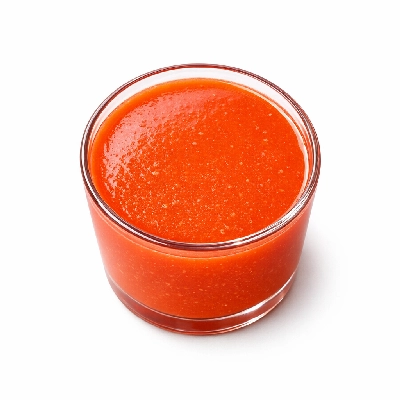
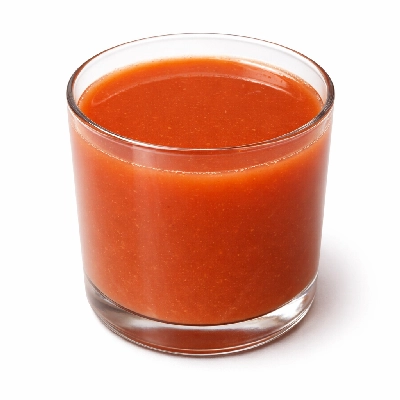
Campbell's V8, Vegetable Juice, High Fiber
Source of Calories
Nutrition Facts
| Nutrient | Amount | % Daily Value |
|---|---|---|
| Total Carbohydrates | 13 g | 5% |
| Net Carbohydrates | 7.9 g | 3% |
| Sugars | 8 g | 23% |
| Added Sugars | No data | - |
| Dietary Fiber | 5.1 g | 18% |
| Protein | 2 g | 4% |
| Total Fat | 0 g | 0% |
| Saturated Fat | 0 g | 0% |
| Monounsaturated Fat | 0 g | - |
| Polyunsaturated Fat | 0 g | - |
| Trans Fat | 0 g | 0% |
| Cholesterol | 0 mg | 0% |
| Vitamins | ||
| Vitamin A | 449.7 mcg | 50% |
| Vitamin C | 72 mg | 80% |
| Vitamin D | No data | - |
| Minerals | ||
| Sodium | 481 mg | 21% |
| Potassium | 469 mg | 10% |
| Calcium | 39 mg | 3% |
| Magnesium | No data | - |
| Iron | 0.7 mg | 4% |
| Zinc | No data | - |
% DV refers to how much a single serving of an individually packaged food or supplement contributes nutritionally to your daily diet, based on a 2,000-calorie-a-day diet. Generally, having 5% DV or less of a nutrient per serving is considered low, and 20% DV or more of a nutrient per serving is considered high.
Vitamin Coverage
Vitamin A
50%
Vitamin C
80%
Vitamin D
-
Vitamin E
0%
Vitamin K
-
Vitamin B1
-
Vitamin B2
-
Vitamin B3
-
Vitamin B5
-
Vitamin B6
-
Vitamin B7
-
Vitamin B9
-
Vitamin B12
-
There are 13 essential vitamins required for the body to work properly, which are categorised into two categories: fat-soluble and water-soluble vitamins. Vitamins have a Recommended Dietary Allowance (RDA), provided by the Dietary Reference Intakes (DRIs), which vary by age and sex. The %DV indicates how much one serving contributes to the average recommended daily intake.
Mineral Coverage
Calcium
3%
Iron
4%
Magnesium
-
Phosphorus
-
Potassium
10%
Sodium
21%
Zinc
-
Copper
-
Manganese
-
Selenium
-
Minerals are micronutrients, of which 13 of them are essential to the human body. The Recommended Dietary Allowance includes Calcium (1,300 mg/d), Phosphorus (1,250 mg/d), Potassium (4,700 mg/d), Sodium (2,300 mg/d), Chloride (1,500 mg/d), Magnesium (420 mg/d), Iron (18 mg/d), Zinc (11 mg/d), Copper (0.9 mg/d), Selenium (55 mcg/d), Molybdenum (45 mcg/d), Manganese (2.3 mg/d) and Iodine (150 mcg/d).
The data provided by eato.health is for informational purposes only and should not be considered medical advice. Please consult your physician before beginning any diet or nutrition plan.
About
How Long to Burn Off 61 Calories?
*Based on this person: 25-year-old female, 5'7", 144 lbs

Swimming
9 min

Jogging
8 min

Cycling
8 min

Walking
15 min
The data provided by eato.health is for informational purposes only and should not be considered medical advice. Please consult your physician before beginning any diet or nutrition plan.
FAQ
Campbell’s V8 High Fiber vegetable juice can be a convenient way to add vegetables, vitamin C, vitamin A, and fiber,, but it si also high in salt (481mg), which is about 21% of the DV for salt intake.
One 8 fl oz serving has 481 mg sodium, which is already 21% DV, so if you plan to consume it everyday, you might want to watch your total daily intake of sodium to ensure it does not overshoot the recommended amount.
Consuming the Campbells V8 vegetable juice, high fiber, can result in a higher sodium intake as there is 481 mg sodium per 8 fl oz, equal to 21% DV, possible reflux symptoms, a rise in blood sugar due to the 13 g of carbs and 8g of sugar, and high levels of potassium (469 mg) for those that are concerned with potassium intake.
For healthy kidneys and liver, V8 vegetable juice is a type of beverage. For 8 oz, there is 481 mg sodium and 469 mg potassium, which may be high for those who have chronic kidney disease, or are watching their sodium and potassium levels.
Yes it could potentially cause acid reflux to be worse as it is tomato based. Acid reflux can be exacerbated by acidic foods, fatty foods and even food with a lot of carbonation.
Food Health: Research and Evidence
Scientific research and expert reviews suggest that certain components in infant formula, such as specific fats and nutrients, can contribute to better cardiovascular health and improved blood sugar control in infants.
1. Food Health: Research and Evidence
Source: SpringerLink, 2024
Summary: Scientific research and expert reviews suggest that certain components in infant formula, such as specific fats and nutrients, can contribute to better cardiovascular health and improved blood sugar control in infants.
Read More: https://link.springer.com/article/10.1007/s13668-024-00561-9
2. Food Health: Research and Evidence
Source: SpringerLink, 2024
Summary: Scientific research and expert reviews suggest that certain components in infant formula, such as specific fats and nutrients, can contribute to better cardiovascular health and improved blood sugar control in infants.
Read More: https://link.springer.com/article/10.1007/s13668-024-00561-9