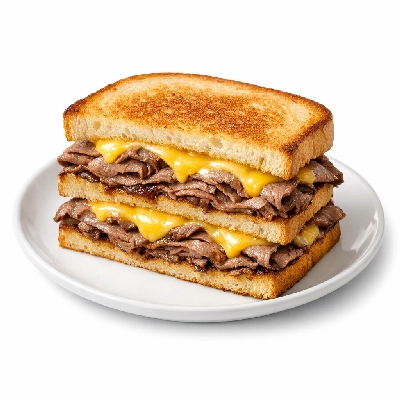
Roast Beef Sandwich, Large with Cheese
Source of Calories
Nutrition Facts
| Nutrient | Amount | % Daily Value |
|---|---|---|
| Total Carbohydrates | 45.37 g | 16% |
| Net Carbohydrates | 45.37 g | 18% |
| Sugars | No data | - |
| Added Sugars | No data | - |
| Dietary Fiber | No data | - |
| Protein | 32.23 g | 64% |
| Total Fat | 18 g | 23% |
| Saturated Fat | 9.03 g | 45% |
| Monounsaturated Fat | 3.66 g | - |
| Polyunsaturated Fat | 3.5 g | - |
| Trans Fat | No data | - |
| Cholesterol | 77.44 mg | 26% |
| Vitamins | ||
| Vitamin A | 58.08 mcg | 6% |
| Vitamin C | 0 mg | 0% |
| Vitamin D | No data | - |
| Minerals | ||
| Sodium | 1633.28 mg | 71% |
| Potassium | 344.96 mg | 7% |
| Calcium | 183.04 mg | 14% |
| Magnesium | 40.48 mg | 10% |
| Iron | 5.05 mg | 28% |
| Zinc | 5.37 mg | 49% |
% DV refers to how much a single serving of an individually packaged food or supplement contributes nutritionally to your daily diet, based on a 2,000-calorie-a-day diet. Generally, having 5% DV or less of a nutrient per serving is considered low, and 20% DV or more of a nutrient per serving is considered high.
Fat Composition
The suggested total fat consumption should be limited to 30% of total energy intake or less. The type of fat consumed should primarily be unsaturated fatty acids, with no more than 10% of total energy intake coming from saturated fatty acids (about 200 calories on a 2000-calorie diet) and no more than 1% of total energy intake coming from trans-fatty acids.
Vitamin Coverage
Vitamin A
6%
Vitamin C
0%
Vitamin D
-
Vitamin E
-
Vitamin K
-
Vitamin B1
32%
Vitamin B2
35%
Vitamin B3
37%
Vitamin B5
14%
Vitamin B6
20%
Vitamin B7
-
Vitamin B9
-
Vitamin B12
86%
There are 13 essential vitamins required for the body to work properly, which are categorised into two categories: fat-soluble and water-soluble vitamins. Vitamins have a Recommended Dietary Allowance (RDA), provided by the Dietary Reference Intakes (DRIs), which vary by age and sex. The %DV indicates how much one serving contributes to the average recommended daily intake.
Mineral Coverage
Calcium
14%
Iron
28%
Magnesium
10%
Phosphorus
32%
Potassium
7%
Sodium
71%
Zinc
49%
Copper
22%
Manganese
14%
Selenium
62%
Minerals are micronutrients, of which 13 of them are essential to the human body. The Recommended Dietary Allowance includes Calcium (1,300 mg/d), Phosphorus (1,250 mg/d), Potassium (4,700 mg/d), Sodium (2,300 mg/d), Chloride (1,500 mg/d), Magnesium (420 mg/d), Iron (18 mg/d), Zinc (11 mg/d), Copper (0.9 mg/d), Selenium (55 mcg/d), Molybdenum (45 mcg/d), Manganese (2.3 mg/d) and Iodine (150 mcg/d).
The data provided by eato.health is for informational purposes only and should not be considered medical advice. Please consult your physician before beginning any diet or nutrition plan.
About
How Long to Burn Off 473 Calories?
*Based on this person: 25-year-old female, 5'7", 144 lbs

Swimming
1 h 10 min

Jogging
60 min

Cycling
1 h 2 min

Walking
1 h 52 min
The data provided by eato.health is for informational purposes only and should not be considered medical advice. Please consult your physician before beginning any diet or nutrition plan.
FAQ
It has 32.23 g of protein, 5.05 mg of iron, 5.37 mg of zinc, 183.04 mg of calcium, and 40.48 mg of magnesium, but it also has 1633.28 mg of sodium, more than half a typical daily limit in one sandwich, along with 9.03 g of saturated fat, 77.44 mg of cholesterol, and 18 g of total fat.
This large roast beef sandwich with cheese contains 473 calories.
It can be, if it uses lean roast beef, minimal cheese, whole grain bread, and plenty of vegetables. However there is also 1633.28 mg of sodium, 9.03 g of saturated fat, and 77.44 mg of cholesterol.
Yes. There is high sodium content, 1633.28 mg, hints that the meat, cheese, bread, or condiments have likely gone through some form of processing or heavy seasoning.
📚 Health Research & Evidence About This Food
Roast beef sandwiches are an important source of protein and vitamin B, contributing significantly to daily energy intake, according to a PubMed study on US consumption patterns. As a food containing meat, roast beef sandwiches provide heme iron, which is readily absorbed and crucial for red blood cell production, a benefit associated with meat consumption as highlighted by Medical News Today in its discussion of nutritional-deficiency anemia. The protein content in roast beef sandwiches may also support muscle maintenance and promote satiety by slowing digestion and stabilizing blood sugar, consistent with observations for high-protein foods like beef snacks.
1. High-Protein Snacks to Build Muscle and Keep Hunger at Bay - Harvard Health
Source: Harvard Health, 2024
Summary: Beef jerky is highlighted as a convenient and high-protein savory snack option that can help increase and maintain muscle mass, aid in weight loss or maintenance by promoting satiety, and stabilize blood sugar.
2. Nutritional-Deficiency Anemia: Causes, Symptoms, and Treatment
Source: Medical News Today, 2019
Summary: Heme iron, found exclusively in meat, is the most readily absorbed form of iron, which is crucial for red blood cell production and function.
3. Consumption of Beef Sandwiches in the United States and Contributions to Intake of Energy and Select Nutrients.
Source: PubMed
Summary: Beef sandwiches contribute significantly to the mean daily energy intake and are an important source of protein and vitamin B in the American diet.
Read More: https://pubmed.ncbi.nlm.nih.gov/38915857/