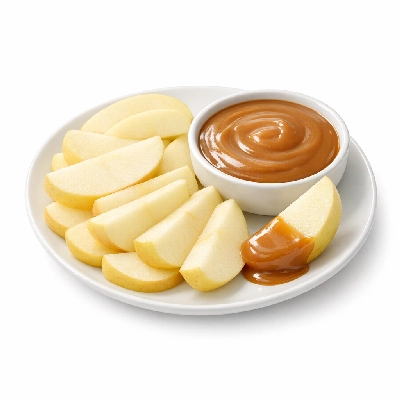
Mcdonald's, Caramel Sauce, Low Fat
Source of Calories
Nutrition Facts
| Nutrient | Amount | % Daily Value |
|---|---|---|
| Total Carbohydrates | 15.02 g | 5% |
| Net Carbohydrates | 15.02 g | 6% |
| Sugars | 9.07 g | 26% |
| Added Sugars | No data | - |
| Dietary Fiber | No data | - |
| Protein | 0.4 g | 1% |
| Total Fat | 0.68 g | 1% |
| Saturated Fat | 0.37 g | 2% |
| Monounsaturated Fat | 0.16 g | - |
| Polyunsaturated Fat | 0.03 g | - |
| Trans Fat | 0.01 g | 100% |
| Cholesterol | 2.52 mg | 1% |
| Vitamins | ||
| Vitamin A | 9.26 mcg | 1% |
| Vitamin C | No data | - |
| Vitamin D | No data | - |
| Minerals | ||
| Sodium | 35.7 mg | 2% |
| Potassium | 24.99 mg | 1% |
| Calcium | 14.91 mg | 1% |
| Magnesium | 1.68 mg | 0% |
| Iron | 0.03 mg | 0% |
| Zinc | 0.06 mg | 1% |
% DV refers to how much a single serving of an individually packaged food or supplement contributes nutritionally to your daily diet, based on a 2,000-calorie-a-day diet. Generally, having 5% DV or less of a nutrient per serving is considered low, and 20% DV or more of a nutrient per serving is considered high.
Fat Composition
The suggested total fat consumption should be limited to 30% of total energy intake or less. The type of fat consumed should primarily be unsaturated fatty acids, with no more than 10% of total energy intake coming from saturated fatty acids (about 200 calories on a 2000-calorie diet) and no more than 1% of total energy intake coming from trans-fatty acids.
Vitamin Coverage
Vitamin A
1%
Vitamin C
-
Vitamin D
-
Vitamin E
0%
Vitamin K
-
Vitamin B1
1%
Vitamin B2
2%
Vitamin B3
0%
Vitamin B5
2%
Vitamin B6
0.3%
Vitamin B7
-
Vitamin B9
-
Vitamin B12
0%
There are 13 essential vitamins required for the body to work properly, which are categorised into two categories: fat-soluble and water-soluble vitamins. Vitamins have a Recommended Dietary Allowance (RDA), provided by the Dietary Reference Intakes (DRIs), which vary by age and sex. The %DV indicates how much one serving contributes to the average recommended daily intake.
Mineral Coverage
Calcium
1%
Iron
0.2%
Magnesium
0.4%
Phosphorus
1%
Potassium
0.5%
Sodium
2%
Zinc
0.5%
Copper
0.4%
Manganese
0.1%
Selenium
-
Minerals are micronutrients, of which 13 of them are essential to the human body. The Recommended Dietary Allowance includes Calcium (1,300 mg/d), Phosphorus (1,250 mg/d), Potassium (4,700 mg/d), Sodium (2,300 mg/d), Chloride (1,500 mg/d), Magnesium (420 mg/d), Iron (18 mg/d), Zinc (11 mg/d), Copper (0.9 mg/d), Selenium (55 mcg/d), Molybdenum (45 mcg/d), Manganese (2.3 mg/d) and Iodine (150 mcg/d).
The data provided by eato.health is for informational purposes only and should not be considered medical advice. Please consult your physician before beginning any diet or nutrition plan.
About
How Long to Burn Off 66 Calories?
*Based on this person: 25-year-old female, 5'7", 144 lbs

Swimming
10 min

Jogging
9 min

Cycling
9 min

Walking
16 min
The data provided by eato.health is for informational purposes only and should not be considered medical advice. Please consult your physician before beginning any diet or nutrition plan.
📚 Health Research & Evidence About This Food
Caramel sauce, like other foods, may be subject to UK regulations for high fat, salt, or sugar foods, which could classify it as 'less healthy' due to its components, restricting its promotion and placement in retail settings.
1. Types of Food Ingredients
Source: FDA, 2024
Summary: Sweeteners are added to provide sweetness, with or without extra calories, and include common examples such as sucrose, glucose, fructose, corn syrup, high fructose corn syrup, and artificial sweeteners like saccharin and aspartame, found in beverages, confections, and many processed foods.
2. Carcinogenic 4(5)-Methylimidazole Found in Beverages, Sauces, and Caramel Colors: Chemical Properties, Analysis, and Biological Activities.
Source: PubMed, 2011
Summary: 4(5)-methylimidazole, a compound identified as a carcinogen, is known to form during the Maillard reaction, a typical method for preparing caramel colors used in various products, and has been detected in caramel color itself.
Read More: https://pubmed.ncbi.nlm.nih.gov/23294412/
3. Restricting Promotions of Products High in Fat, Sugar or Salt by Location and by Volume Price: Implementation Guidance - Gov.Uk
Source: GOV.UK, 2022
Summary: Caramel sauce is a component of McDonald's low-fat caramel sauce, which is subject to UK government regulations restricting the promotion and placement of foods high in fat, salt, or sugar (HFSS) if it falls under specified categories and scores as 'less healthy' according to the Nutrient Profiling Model.
4. 5 Top Foods That Cause Inflammation
Source: Cleveland Clinic
Summary: Added sugars, a primary culprit in increasing inflammation, rapidly raise blood sugar and insulin levels, promoting a pro-inflammatory state that can lead to insulin resistance and weight gain.
Read More: https://health.clevelandclinic.org/foods-that-can-cause-inflammation