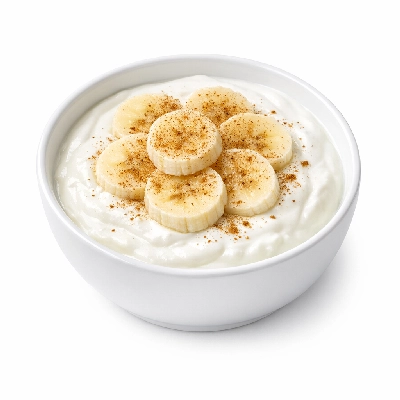
Cinnamon Greek Yogurt with Banana Slices
Source of Calories
Nutrition Facts
| Nutrient | Amount | % Daily Value |
|---|---|---|
| Total Carbohydrates | 37.48 g | 14% |
| Net Carbohydrates | 33.77 g | 14% |
| Sugars | 23.63 g | 68% |
| Added Sugars | No data | - |
| Dietary Fiber | 3.71 g | 13% |
| Protein | 22.95 g | 46% |
| Total Fat | 12.41 g | 16% |
| Saturated Fat | 5.86 g | 29% |
| Monounsaturated Fat | 5.14 g | - |
| Polyunsaturated Fat | 1.23 g | - |
| Trans Fat | 0 g | 0% |
| Cholesterol | 31.2 mg | 10% |
| Vitamins | ||
| Vitamin A | 7.76 mcg | 1% |
| Vitamin C | 10.04 mg | 11% |
| Vitamin D | 0 mcg | 0% |
| Minerals | ||
| Sodium | 85.32 mg | 4% |
| Potassium | 765.36 mg | 16% |
| Calcium | 257.42 mg | 20% |
| Magnesium | 59.09 mg | 14% |
| Iron | 0.4 mg | 2% |
| Zinc | 1.47 mg | 13% |
% DV refers to how much a single serving of an individually packaged food or supplement contributes nutritionally to your daily diet, based on a 2,000-calorie-a-day diet. Generally, having 5% DV or less of a nutrient per serving is considered low, and 20% DV or more of a nutrient per serving is considered high.
Fat Composition
The suggested total fat consumption should be limited to 30% of total energy intake or less. The type of fat consumed should primarily be unsaturated fatty acids, with no more than 10% of total energy intake coming from saturated fatty acids (about 200 calories on a 2000-calorie diet) and no more than 1% of total energy intake coming from trans-fatty acids.
Vitamin Coverage
Vitamin A
0.9%
Vitamin C
11%
Vitamin D
0%
Vitamin E
1%
Vitamin K
0.8%
Vitamin B1
4%
Vitamin B2
59%
Vitamin B3
8%
Vitamin B5
24%
Vitamin B6
32%
Vitamin B7
0%
Vitamin B9
6%
Vitamin B12
75%
There are 13 essential vitamins required for the body to work properly, which are categorised into two categories: fat-soluble and water-soluble vitamins. Vitamins have a Recommended Dietary Allowance (RDA), provided by the Dietary Reference Intakes (DRIs), which vary by age and sex. The %DV indicates how much one serving contributes to the average recommended daily intake.
Mineral Coverage
Calcium
20%
Iron
2%
Magnesium
14%
Phosphorus
28%
Potassium
16%
Sodium
4%
Zinc
13%
Copper
17%
Manganese
23%
Selenium
45%
Minerals are micronutrients, of which 13 of them are essential to the human body. The Recommended Dietary Allowance includes Calcium (1,300 mg/d), Phosphorus (1,250 mg/d), Potassium (4,700 mg/d), Sodium (2,300 mg/d), Chloride (1,500 mg/d), Magnesium (420 mg/d), Iron (18 mg/d), Zinc (11 mg/d), Copper (0.9 mg/d), Selenium (55 mcg/d), Molybdenum (45 mcg/d), Manganese (2.3 mg/d) and Iodine (150 mcg/d).
Protein Quality
Leucine
3%
Isoleucine
2%
Valine
3%
Lysine
2%
Tryptophan
3%
Threonine
2%
Phenylalanine
5%
Methionine
1%
Histidine
9%
Guidelines recommend a serving of protein with each meal and 1.2-1.6 g of protein per kg of body weight per day.
The data provided by eato.health is for informational purposes only and should not be considered medical advice. Please consult your physician before beginning any diet or nutrition plan.
About
How Long to Burn Off 341 Calories?
*Based on this person: 25-year-old female, 5'7", 144 lbs

Swimming
50 min

Jogging
43 min

Cycling
45 min

Walking
1 h 20 min
The data provided by eato.health is for informational purposes only and should not be considered medical advice. Please consult your physician before beginning any diet or nutrition plan.
📚 Health Research & Evidence About This Food
Greek yogurt is recognized for its high protein content and its ability to influence the gut microbiome. Mechanistic studies indicate it actively reshapes the gut microbiome and influences host physiology through its starter cultures, with specific bacterial types linked to the production of short-chain fatty acids, stabilization of gut lining function, and adjustment of immunity patterns. This strained variety is richer in probiotics and often contains more protein than regular yogurt, with lower sugar and carbohydrates, which may support immune health and contribute to improved digestion and balanced gut bacteria.
1. Fermented Dairy Products as Modulators of the Gut Microbiome: Greek Yogurt as a Model System
Source: Wiley Online Library
Summary: Greek yogurt, with its distinct characteristics including higher protein content and reduced lactose levels, actively reshapes the gut microbiome and influences host physiology through its starter cultures.
Read More: https://onlinelibrary.wiley.com/doi/full/10.1002/fsn3.71872
2. Health Benefits of Yogurt: Nutrition, Types, and Care
Source: WebMD
Summary: Greek yogurt is a strained, denser variety that is richer in probiotics and often contains up to twice the protein of regular yogurt, with lower sugar, carbohydrates, and calories, supporting thyroid function and immune health.
Read More: https://www.webmd.com/diet/health-benefits-yogurt
3. Impact of Yogurt and Rolled Oats Consumption on the Gut Microbiome: A Randomized Crossover Study Displaying Individual Responses and General Resilience.
Source: PubMed
Summary: Yogurt consumption transiently increased yogurt-associated bacteria, specifically Streptococcus thermophilus, which rose from absent to nearly detectable levels in both intervention groups.
Read More: https://pubmed.ncbi.nlm.nih.gov/41687784/
4. Cinnamon: Health Benefits and Nutrition
Source: Medical News Today, 2020
Summary: Cinnamon possesses various antioxidant, anti-inflammatory, and antimicrobial properties, and may influence blood sugar levels and offer protective effects against certain diseases.