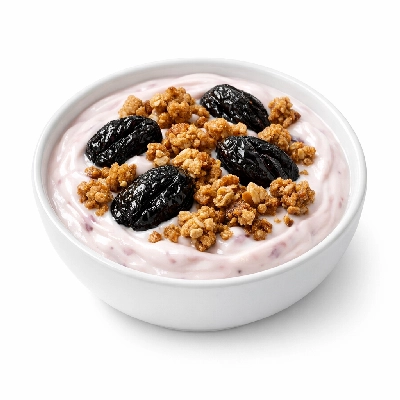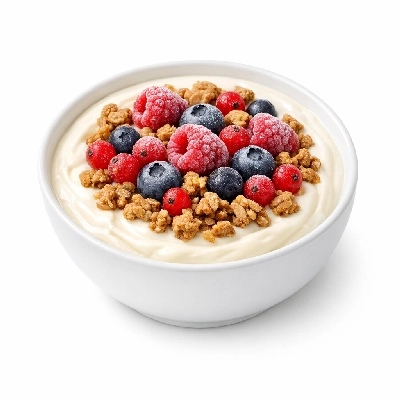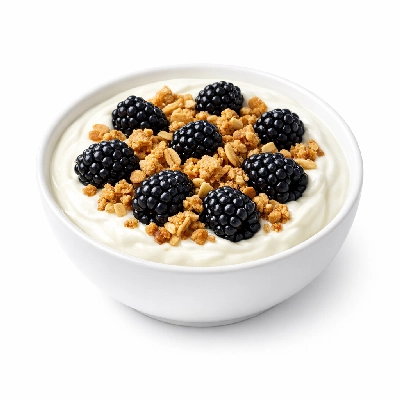
Yogurt with Granola & Blackberries
Source of Calories
Nutrition Facts
| Nutrient | Amount | % Daily Value |
|---|---|---|
| Total Carbohydrates | 56.2 g | 20% |
| Net Carbohydrates | 46.1 g | 19% |
| Sugars | 39.28 g | 112% |
| Added Sugars | 22.24 g | 44% |
| Dietary Fiber | 10.1 g | 36% |
| Protein | 28.3 g | 57% |
| Total Fat | 8.67 g | 11% |
| Saturated Fat | 0.96 g | 5% |
| Monounsaturated Fat | 3.18 g | - |
| Polyunsaturated Fat | 3.56 g | - |
| Trans Fat | 0.03 g | 100% |
| Cholesterol | 11.56 mg | 4% |
| Vitamins | ||
| Vitamin A | 26.4 mcg | 3% |
| Vitamin C | 30.56 mg | 34% |
| Vitamin D | 0.13 mcg | 1% |
| Minerals | ||
| Sodium | 92.98 mg | 4% |
| Potassium | 686.39 mg | 15% |
| Calcium | 330.89 mg | 25% |
| Magnesium | 89.43 mg | 21% |
| Iron | 2.17 mg | 12% |
| Zinc | 2.87 mg | 26% |
% DV refers to how much a single serving of an individually packaged food or supplement contributes nutritionally to your daily diet, based on a 2,000-calorie-a-day diet. Generally, having 5% DV or less of a nutrient per serving is considered low, and 20% DV or more of a nutrient per serving is considered high.
Fat Composition
The suggested total fat consumption should be limited to 30% of total energy intake or less. The type of fat consumed should primarily be unsaturated fatty acids, with no more than 10% of total energy intake coming from saturated fatty acids (about 200 calories on a 2000-calorie diet) and no more than 1% of total energy intake coming from trans-fatty acids.
Vitamin Coverage
Vitamin A
3%
Vitamin C
34%
Vitamin D
0.7%
Vitamin E
22%
Vitamin K
37%
Vitamin B1
17%
Vitamin B2
56%
Vitamin B3
12%
Vitamin B5
28%
Vitamin B6
16%
Vitamin B7
10%
Vitamin B9
16%
Vitamin B12
73%
There are 13 essential vitamins required for the body to work properly, which are categorised into two categories: fat-soluble and water-soluble vitamins. Vitamins have a Recommended Dietary Allowance (RDA), provided by the Dietary Reference Intakes (DRIs), which vary by age and sex. The %DV indicates how much one serving contributes to the average recommended daily intake.
Mineral Coverage
Calcium
25%
Iron
12%
Magnesium
21%
Phosphorus
35%
Potassium
15%
Sodium
4%
Zinc
26%
Copper
46%
Manganese
77%
Selenium
53%
Minerals are micronutrients, of which 13 of them are essential to the human body. The Recommended Dietary Allowance includes Calcium (1,300 mg/d), Phosphorus (1,250 mg/d), Potassium (4,700 mg/d), Sodium (2,300 mg/d), Chloride (1,500 mg/d), Magnesium (420 mg/d), Iron (18 mg/d), Zinc (11 mg/d), Copper (0.9 mg/d), Selenium (55 mcg/d), Molybdenum (45 mcg/d), Manganese (2.3 mg/d) and Iodine (150 mcg/d).
Protein Quality
Leucine
83%
Isoleucine
97%
Valine
84%
Lysine
81%
Tryptophan
138%
Threonine
89%
Phenylalanine
88%
Methionine
80%
Histidine
60%
Guidelines recommend a serving of protein with each meal and 1.2-1.6 g of protein per kg of body weight per day.
The data provided by eato.health is for informational purposes only and should not be considered medical advice. Please consult your physician before beginning any diet or nutrition plan.
About
How Long to Burn Off 398 Calories?
*Based on this person: 25-year-old female, 5'7", 144 lbs

Swimming
59 min

Jogging
51 min

Cycling
52 min

Walking
1 h 34 min
The data provided by eato.health is for informational purposes only and should not be considered medical advice. Please consult your physician before beginning any diet or nutrition plan.
📚 Health Research & Evidence About This Food
Yogurt, a fermented dairy product, is a significant source of probiotics, including *Lactobacillus acidophilus* and *Bifidobacterium*; a probiotic variant of yogurt has been shown to effectively reduce antibiotic-associated diarrhea in children, as demonstrated in a double-blind, randomized, placebo-controlled clinical trial. Harvard Health notes that yogurt also provides calcium and protein, and studies show that both regular and fiber-enriched drinking yogurts are more satiating than other low-energy snacks, leading to lower subsequent food intake, with fiber-enriched yogurt tending to be the most satiating among tested foods.
1. Can Probiotic Yogurt Prevent Diarrhoea in Children on Antibiotics? A Double-Blind, Randomised, Placebo-Controlled Study.
Source: PubMed
Summary: A yogurt combination of Lactobacillus rhamnosus GG, Lactobacillus acidophilus, and Bifidobacterium lactis is an effective method for reducing the incidence of antibiotic-associated diarrhoea in children.
Read More: https://pubmed.ncbi.nlm.nih.gov/25588782/
2. Impact of Some Isoenergetic Snacks on Satiety and Next Meal Intake in Healthy Adults.
Source: PubMed
Summary: Both regular and fiber-enriched drinking yogurts were significantly more satiating than water and crackers, leading to lower subsequent food intake.
Read More: https://pubmed.ncbi.nlm.nih.gov/19743984/
3. Want Probiotics but Dislike Yogurt? Try These Foods - Harvard Health
Source: Harvard Health, 2021
Summary: Yogurt is a significant source of probiotics, calcium, and protein, containing common probiotics such as *Lactobacillus acidophilus* and *Bifidobacterium*.
Read More: https://www.health.harvard.edu/blog/want-probiotics-but-dislike-yogurt-try-these-foods-202107142918
4. Yogurt 101: Nutrition Facts and Health Benefits
Source: Healthline, 2019
Summary: Yogurt is a fermented dairy product made by adding live bacteria to milk, offering various health benefits, particularly when it contains live and active cultures.
Read More: https://www.healthline.com/nutrition/foods/yogurt