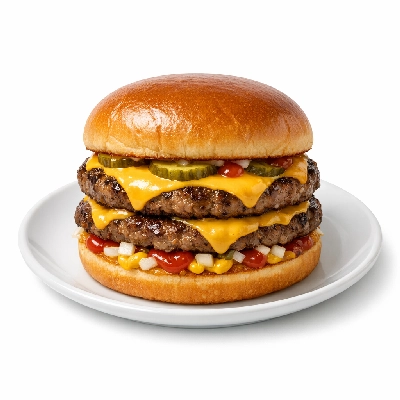
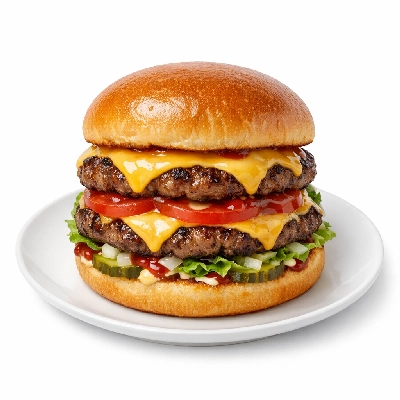
Wendy's, Double Stack with Cheese
Source of Calories
Nutrition Facts
| Nutrient | Amount | % Daily Value |
|---|---|---|
| Total Carbohydrates | 22.41 g | 8% |
| Net Carbohydrates | 22.41 g | 9% |
| Sugars | 5.65 g | 16% |
| Added Sugars | No data | - |
| Dietary Fiber | No data | - |
| Protein | 27.05 g | 54% |
| Total Fat | 24.24 g | 31% |
| Saturated Fat | 10 g | 50% |
| Monounsaturated Fat | 10.61 g | - |
| Polyunsaturated Fat | 1.85 g | - |
| Trans Fat | 1.34 g | 100% |
| Cholesterol | No data | - |
| Vitamins | ||
| Vitamin A | No data | - |
| Vitamin C | No data | - |
| Vitamin D | No data | - |
| Minerals | ||
| Sodium | 696.42 mg | 30% |
| Potassium | 376.68 mg | 8% |
| Calcium | 106.58 mg | 8% |
| Magnesium | 30.66 mg | 7% |
| Iron | 4.02 mg | 22% |
| Zinc | 4.92 mg | 45% |
% DV refers to how much a single serving of an individually packaged food or supplement contributes nutritionally to your daily diet, based on a 2,000-calorie-a-day diet. Generally, having 5% DV or less of a nutrient per serving is considered low, and 20% DV or more of a nutrient per serving is considered high.
Fat Composition
The suggested total fat consumption should be limited to 30% of total energy intake or less. The type of fat consumed should primarily be unsaturated fatty acids, with no more than 10% of total energy intake coming from saturated fatty acids (about 200 calories on a 2000-calorie diet) and no more than 1% of total energy intake coming from trans-fatty acids.
Mineral Coverage
Calcium
8%
Iron
22%
Magnesium
7%
Phosphorus
18%
Potassium
8%
Sodium
30%
Zinc
45%
Copper
14%
Manganese
11%
Selenium
-
Minerals are micronutrients, of which 13 of them are essential to the human body. The Recommended Dietary Allowance includes Calcium (1,300 mg/d), Phosphorus (1,250 mg/d), Potassium (4,700 mg/d), Sodium (2,300 mg/d), Chloride (1,500 mg/d), Magnesium (420 mg/d), Iron (18 mg/d), Zinc (11 mg/d), Copper (0.9 mg/d), Selenium (55 mcg/d), Molybdenum (45 mcg/d), Manganese (2.3 mg/d) and Iodine (150 mcg/d).
The data provided by eato.health is for informational purposes only and should not be considered medical advice. Please consult your physician before beginning any diet or nutrition plan.
About
How Long to Burn Off 416 Calories?
*Based on this person: 25-year-old female, 5'7", 144 lbs

Swimming
1 h 1 min

Jogging
53 min

Cycling
54 min

Walking
1 h 38 min
The data provided by eato.health is for informational purposes only and should not be considered medical advice. Please consult your physician before beginning any diet or nutrition plan.
📚 Health Research & Evidence About This Food
A double stack with cheese, like other hamburgers, contains a patty that, if prepared as a high-SFA hamburger, may contribute to increased plasma triglycerides and decreased HDL cholesterol by altering hepatic stearoyl-CoA desaturase activity, according to research on hamburger consumption.
1. Calorie Count - Fast Food: Medlineplus Medical Encyclopedia
Source: MedlinePlus
Summary: A Wendy's Double Stack sandwich contains calories.
Read More: https://medlineplus.gov/ency/patientinstructions/000887.htm
2. Human Gut Microbiome Composition and Tryptophan Metabolites Were Changed Differently by Fast Food and Mediterranean Diet in 4 Days: A Pilot Study.
Source: PubMed
Summary: A fast food diet, characterized by burgers and fries, significantly altered human gut microbiome composition and its metabolites in a very short timeframe, increasing certain bile-tolerant microbial genera and species while decreasing beneficial bacterially produced metabolites.
Read More: https://pubmed.ncbi.nlm.nih.gov/32330749/
3. Hamburger High in Total, Saturated and Trans-Fatty Acids Decreases Hdl Cholesterol and Ldl Particle Diameter, and Increases Tag, in Mildly Hypercholesterolaemic Men.
Source: PubMed
Summary: High-SFA hamburgers significantly increased plasma palmitic acid, palmitoleic acid, and triglycerides, while decreasing HDL cholesterol and LDL particle diameter percentile distributions in mildly hypercholesterolaemic men.
Read More: https://pubmed.ncbi.nlm.nih.gov/19674491/
4. Detailed Characterization of Plant-Based Burgers
Source: Nature, 2021
Summary: Meat-based burgers generally had lower pH and carbohydrate content compared to plant-based burgers.
Read More: https://www.nature.com/articles/s41598-021-81684-9
5. Trends in the Healthiness of U.S. Fast Food Meals, 2008–2017
Source: Nature, 2020
Summary: Fast food meals in the United States showed a significant decrease in the proportion adhering to the American Heart Association's calorie criterion compared to an earlier period, and a similar reduction in total fat in recent years.
Read More: https://www.nature.com/articles/s41430-020-00788-z