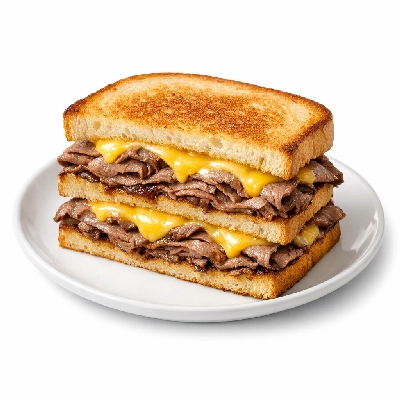
Sandwiches and Burgers Steak
Source of Calories
Nutrition Facts
| Nutrient | Amount | % Daily Value |
|---|---|---|
| Total Carbohydrates | 52 g | 19% |
| Net Carbohydrates | 52 g | 21% |
| Sugars | No data | - |
| Added Sugars | No data | - |
| Dietary Fiber | No data | - |
| Protein | 30 g | 60% |
| Total Fat | 14 g | 18% |
| Saturated Fat | 3.8 g | 19% |
| Monounsaturated Fat | 5.3 g | - |
| Polyunsaturated Fat | 3.3 g | - |
| Trans Fat | No data | - |
| Cholesterol | 73 mg | 24% |
| Vitamins | ||
| Vitamin A | 109.5 mcg | 12% |
| Vitamin C | 5.52 mg | 6% |
| Vitamin D | No data | - |
| Minerals | ||
| Sodium | 798 mg | 35% |
| Potassium | 524 mg | 11% |
| Calcium | 92 mg | 7% |
| Magnesium | 48 mg | 11% |
| Iron | 5.22 mg | 29% |
| Zinc | 4.5 mg | 41% |
% DV refers to how much a single serving of an individually packaged food or supplement contributes nutritionally to your daily diet, based on a 2,000-calorie-a-day diet. Generally, having 5% DV or less of a nutrient per serving is considered low, and 20% DV or more of a nutrient per serving is considered high.
Fat Composition
The suggested total fat consumption should be limited to 30% of total energy intake or less. The type of fat consumed should primarily be unsaturated fatty acids, with no more than 10% of total energy intake coming from saturated fatty acids (about 200 calories on a 2000-calorie diet) and no more than 1% of total energy intake coming from trans-fatty acids.
Vitamin Coverage
Vitamin A
12%
Vitamin C
6%
Vitamin D
-
Vitamin E
-
Vitamin K
-
Vitamin B1
34%
Vitamin B2
29%
Vitamin B3
46%
Vitamin B5
18%
Vitamin B6
21%
Vitamin B7
-
Vitamin B9
-
Vitamin B12
65%
There are 13 essential vitamins required for the body to work properly, which are categorised into two categories: fat-soluble and water-soluble vitamins. Vitamins have a Recommended Dietary Allowance (RDA), provided by the Dietary Reference Intakes (DRIs), which vary by age and sex. The %DV indicates how much one serving contributes to the average recommended daily intake.
Mineral Coverage
Calcium
7%
Iron
29%
Magnesium
11%
Phosphorus
24%
Potassium
11%
Sodium
35%
Zinc
41%
Copper
24%
Manganese
16%
Selenium
76%
Minerals are micronutrients, of which 13 of them are essential to the human body. The Recommended Dietary Allowance includes Calcium (1,300 mg/d), Phosphorus (1,250 mg/d), Potassium (4,700 mg/d), Sodium (2,300 mg/d), Chloride (1,500 mg/d), Magnesium (420 mg/d), Iron (18 mg/d), Zinc (11 mg/d), Copper (0.9 mg/d), Selenium (55 mcg/d), Molybdenum (45 mcg/d), Manganese (2.3 mg/d) and Iodine (150 mcg/d).
The data provided by eato.health is for informational purposes only and should not be considered medical advice. Please consult your physician before beginning any diet or nutrition plan.
About
How Long to Burn Off 459 Calories?
*Based on this person: 25-year-old female, 5'7", 144 lbs

Swimming
1 h 8 min

Jogging
58 min

Cycling
60 min

Walking
1 h 48 min
The data provided by eato.health is for informational purposes only and should not be considered medical advice. Please consult your physician before beginning any diet or nutrition plan.
📚 Health Research & Evidence About This Food
Sandwiches and burgers steak, via their steak component, may be associated with findings on beef preparations that contribute to satiety, with physical characteristics and energy density influencing these properties in studies with healthy volunteers; however, consuming red meat like steak may be associated with a higher risk of premature death from all causes, particularly for prostate cancer survivors, according to the American Cancer Society, with research indicating this risk for those consuming red or processed meat before or after diagnosis. Furthermore, sandwiches are a potential source of Staphylococcus aureus food poisoning, especially when not cooked after handling, with symptoms appearing rapidly, as noted by the CDC.
1. The Steak and Barium Meal
Source: SpringerLink
Summary: Beefsteak, when consumed by male subjects who have undergone partial gastrectomy, empties from the gastric remnant at a measurable rate, as observed through serial X-ray examinations after a meal of beefsteak and barium.
Read More: https://link.springer.com/article/10.1007/BF02283886
2. Food Poisoning Symptoms
Source: CDC, 2025
Summary: Sandwiches are a potential source of Staphylococcus aureus food poisoning, especially when not cooked after handling.
Read More: https://www.cdc.gov/food-safety/signs-symptoms/index.html
3. Satiating Properties of Meat-Preparations: Role of Protein Content and Energy Density.
Source: PubMed
Summary: The satiating properties of beef preparations are primarily influenced by their physical characteristics and energy density, rather than solely by protein content.
Read More: https://pubmed.ncbi.nlm.nih.gov/18689555/
4. Study Shows Prostate Cancer Survivors Who Eat More Chicken and Less Steak May Live Longer
Source: American Cancer Society
Summary: Consuming red or processed meat, including steak, either before or after a nonmetastatic prostate cancer diagnosis, was associated with a higher risk of premature death from all causes.
5. Best Protein-Rich Foods for Diabetes
Source: American Diabetes Association
Summary: Lean cuts of beef, such as Select or Choice grades trimmed of fat, including chuck, rib, rump roast, round, sirloin, cubed, flank, porterhouse, T-bone steak, or tenderloin, are appropriate choices for a diabetes-friendly diet.
Read More: https://diabetes.org/food-nutrition/reading-food-labels/protein