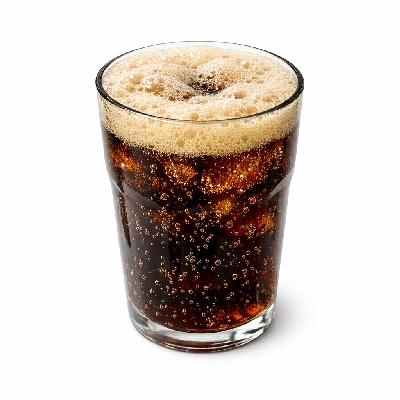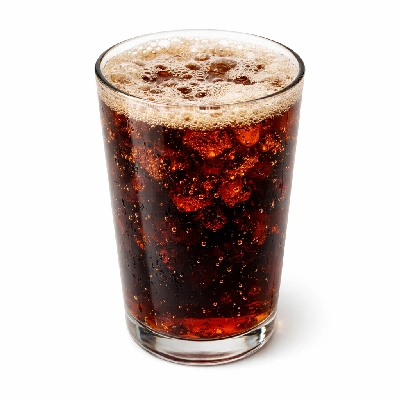
Dr. Pepper
Source of Calories
Nutrition Facts
| Nutrient | Amount | % Daily Value |
|---|---|---|
| Total Carbohydrates | 3.19 g | 1% |
| Net Carbohydrates | 3.19 g | 1% |
| Sugars | No data | - |
| Added Sugars | No data | - |
| Dietary Fiber | 0 g | 0% |
| Protein | 0 g | 0% |
| Total Fat | 0.03 g | 0% |
| Saturated Fat | 0.02 g | 0% |
| Monounsaturated Fat | 0 g | - |
| Polyunsaturated Fat | 0 g | - |
| Trans Fat | 0 g | 0% |
| Cholesterol | 0 mg | 0% |
| Vitamins | ||
| Vitamin A | 0 mcg | 0% |
| Vitamin C | 0 mg | 0% |
| Vitamin D | No data | - |
| Minerals | ||
| Sodium | 3.07 mg | 0% |
| Potassium | 0.31 mg | 0% |
| Calcium | 0.92 mg | 0% |
| Magnesium | 0 mg | 0% |
| Iron | 0.01 mg | 0% |
| Zinc | 0.01 mg | 0% |
% DV refers to how much a single serving of an individually packaged food or supplement contributes nutritionally to your daily diet, based on a 2,000-calorie-a-day diet. Generally, having 5% DV or less of a nutrient per serving is considered low, and 20% DV or more of a nutrient per serving is considered high.
Fat Composition
The suggested total fat consumption should be limited to 30% of total energy intake or less. The type of fat consumed should primarily be unsaturated fatty acids, with no more than 10% of total energy intake coming from saturated fatty acids (about 200 calories on a 2000-calorie diet) and no more than 1% of total energy intake coming from trans-fatty acids.
Vitamin Coverage
Vitamin A
0%
Vitamin C
0%
Vitamin D
-
Vitamin E
-
Vitamin K
-
Vitamin B1
0%
Vitamin B2
0%
Vitamin B3
0%
Vitamin B5
0%
Vitamin B6
0%
Vitamin B7
-
Vitamin B9
0%
Vitamin B12
0%
There are 13 essential vitamins required for the body to work properly, which are categorised into two categories: fat-soluble and water-soluble vitamins. Vitamins have a Recommended Dietary Allowance (RDA), provided by the Dietary Reference Intakes (DRIs), which vary by age and sex. The %DV indicates how much one serving contributes to the average recommended daily intake.
Mineral Coverage
Calcium
0.1%
Iron
0.1%
Magnesium
0%
Phosphorus
0.3%
Potassium
0%
Sodium
0.1%
Zinc
0.1%
Copper
0.2%
Manganese
0.5%
Selenium
0.1%
Minerals are micronutrients, of which 13 of them are essential to the human body. The Recommended Dietary Allowance includes Calcium (1,300 mg/d), Phosphorus (1,250 mg/d), Potassium (4,700 mg/d), Sodium (2,300 mg/d), Chloride (1,500 mg/d), Magnesium (420 mg/d), Iron (18 mg/d), Zinc (11 mg/d), Copper (0.9 mg/d), Selenium (55 mcg/d), Molybdenum (45 mcg/d), Manganese (2.3 mg/d) and Iodine (150 mcg/d).
Protein Quality
Leucine
0%
Isoleucine
0%
Valine
0%
Lysine
0%
Tryptophan
0%
Threonine
0%
Phenylalanine
0%
Methionine
0%
Histidine
0%
Guidelines recommend a serving of protein with each meal and 1.2-1.6 g of protein per kg of body weight per day.
The data provided by eato.health is for informational purposes only and should not be considered medical advice. Please consult your physician before beginning any diet or nutrition plan.
About
How Long to Burn Off 13 Calories?
*Based on this person: 25-year-old female, 5'7", 144 lbs

Swimming
2 min

Jogging
2 min

Cycling
2 min

Walking
3 min
The data provided by eato.health is for informational purposes only and should not be considered medical advice. Please consult your physician before beginning any diet or nutrition plan.
📚 Health Research & Evidence About This Food
Dr. Pepper, as a type of regular soda, shares the general characteristics of such beverages, which MedlinePlus highlights as contributing significant calories without substantial nutrients due to high added sugar content. Like other sugar-sweetened soft drinks, it is associated with greater weight gain and an elevated risk of developing type 2 diabetes in women, as demonstrated by clinical evidence from a prospective cohort study in the Nurses' Health Study II. Additionally, Dr. Pepper, like most carbonated beverages, exhibits a low pH, posing a comparable risk for dental erosion, a finding noted by a Wiley Online Library study on carbonated beverages.
1. Calorie Count - Sodas and Energy Drinks: Medlineplus Medical Encyclopedia
Source: MedlinePlus
Summary: Sodas and energy drinks often contribute significant calories without offering substantial nutrients, primarily due to their high added sugar content.
Read More: https://medlineplus.gov/ency/patientinstructions/000888.htm
2. Rethink Your Drink
Source: CDC, 2026
Summary: Regular soda, including Dr. Pepper, contains sugar and calories per serving, contributing to health concerns when consumed frequently.
Read More: https://www.cdc.gov/healthy-weight-growth/rethink-your-drink/index.html
3. Impact of Soft Drinks to Health and Economy: A Critical Review
Source: SpringerLink
Summary: Many commercial soft drinks are characterized by high sugar content and acidity, providing only energy with minimal nutritional value, lacking essential micronutrients, vitamins, and minerals, and their consumption is strongly linked to detrimental oral and general health outcomes.
Read More: https://link.springer.com/article/10.1007/s40368-019-00458-0
4. Sugar-Sweetened Beverages, Weight Gain, and Incidence of Type 2 Diabetes in Young and Middle-Aged Women.
Source: PubMed
Summary: Sugar-sweetened soft drinks are linked to greater weight gain and an elevated risk of developing type 2 diabetes in women.
Read More: https://pubmed.ncbi.nlm.nih.gov/15328324/
5. Evaluation of Tooth Erosion Potential of Zero and Carbonated Beverages in Korea: A Laboratory‐Based Study Focused on Ph
Source: Wiley Online Library
Summary: Dr. Pepper, like the majority of both regular and zero-calorie carbonated beverages, exhibits a low pH, posing a comparable risk for dental erosion.
Read More: https://onlinelibrary.wiley.com/doi/full/10.1111/idh.70069