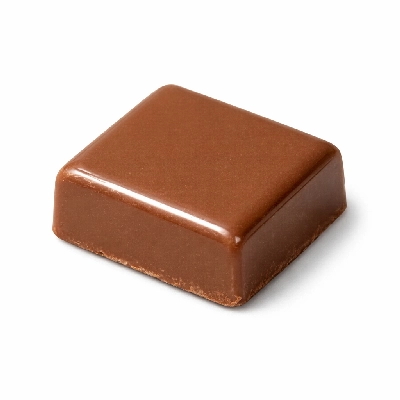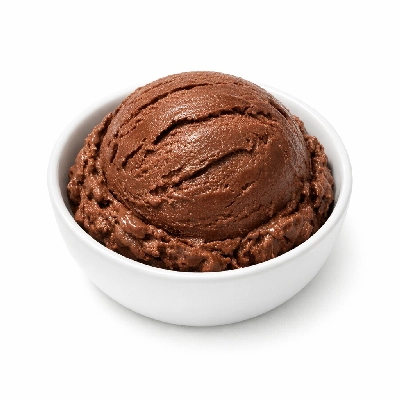
Chocolate Ice Cream
Source of Calories
Nutrition Facts
| Nutrient | Amount | % Daily Value |
|---|---|---|
| Total Carbohydrates | 16.36 g | 6% |
| Net Carbohydrates | 15.66 g | 6% |
| Sugars | 14.71 g | 42% |
| Added Sugars | 12.64 g | 25% |
| Dietary Fiber | 0.7 g | 2% |
| Protein | 2.2 g | 4% |
| Total Fat | 6.38 g | 8% |
| Saturated Fat | 3.94 g | 20% |
| Monounsaturated Fat | 1.86 g | - |
| Polyunsaturated Fat | 0.24 g | - |
| Trans Fat | No data | - |
| Cholesterol | 19.72 mg | 7% |
| Vitamins | ||
| Vitamin A | 68.2 mcg | 8% |
| Vitamin C | 0.41 mg | 0% |
| Vitamin D | 0.12 mcg | 1% |
| Minerals | ||
| Sodium | 44.08 mg | 2% |
| Potassium | 144.42 mg | 3% |
| Calcium | 63.22 mg | 5% |
| Magnesium | 16.82 mg | 4% |
| Iron | 0.54 mg | 3% |
| Zinc | 0.34 mg | 3% |
% DV refers to how much a single serving of an individually packaged food or supplement contributes nutritionally to your daily diet, based on a 2,000-calorie-a-day diet. Generally, having 5% DV or less of a nutrient per serving is considered low, and 20% DV or more of a nutrient per serving is considered high.
Fat Composition
The suggested total fat consumption should be limited to 30% of total energy intake or less. The type of fat consumed should primarily be unsaturated fatty acids, with no more than 10% of total energy intake coming from saturated fatty acids (about 200 calories on a 2000-calorie diet) and no more than 1% of total energy intake coming from trans-fatty acids.
Vitamin Coverage
Vitamin A
8%
Vitamin C
0.5%
Vitamin D
0.6%
Vitamin E
1%
Vitamin K
0.1%
Vitamin B1
2%
Vitamin B2
9%
Vitamin B3
0.8%
Vitamin B5
6%
Vitamin B6
2%
Vitamin B7
-
Vitamin B9
2%
Vitamin B12
7%
There are 13 essential vitamins required for the body to work properly, which are categorised into two categories: fat-soluble and water-soluble vitamins. Vitamins have a Recommended Dietary Allowance (RDA), provided by the Dietary Reference Intakes (DRIs), which vary by age and sex. The %DV indicates how much one serving contributes to the average recommended daily intake.
Mineral Coverage
Calcium
5%
Iron
3%
Magnesium
4%
Phosphorus
5%
Potassium
3%
Sodium
2%
Zinc
3%
Copper
9%
Manganese
4%
Selenium
3%
Minerals are micronutrients, of which 13 of them are essential to the human body. The Recommended Dietary Allowance includes Calcium (1,300 mg/d), Phosphorus (1,250 mg/d), Potassium (4,700 mg/d), Sodium (2,300 mg/d), Chloride (1,500 mg/d), Magnesium (420 mg/d), Iron (18 mg/d), Zinc (11 mg/d), Copper (0.9 mg/d), Selenium (55 mcg/d), Molybdenum (45 mcg/d), Manganese (2.3 mg/d) and Iodine (150 mcg/d).
The data provided by eato.health is for informational purposes only and should not be considered medical advice. Please consult your physician before beginning any diet or nutrition plan.
About
How Long to Burn Off 125 Calories?
*Based on this person: 25-year-old female, 5'7", 144 lbs

Swimming
19 min

Jogging
16 min

Cycling
17 min

Walking
30 min
The data provided by eato.health is for informational purposes only and should not be considered medical advice. Please consult your physician before beginning any diet or nutrition plan.
📚 Health Research & Evidence About This Food
Ice cream is generally a calorie-dense food, typically high in added sugar and fat, and is not considered a health food comparable to fruits or vegetables, according to Healthline and Cleveland Clinic, which note that even "healthier" versions may contain artificial ingredients or sugar alcohols that can cause digestive issues. Despite this, a systematic review and meta-analysis investigating various dairy types, including ice cream, found an inverse association between moderate total dairy and cheese intake and the prevention of prediabetes. Furthermore, daily consumption of calcium-fortified ice cream has been shown to reduce bone resorption markers like serum CTX in premenopausal women with low calcium intakes without causing weight gain, with effects observed within one hour of consumption.
1. Effects of Calcium-Fortified Ice Cream on Markers of Bone Health.
Source: PubMed
Summary: Daily intake of calcium-fortified ice cream significantly reduces levels of the bone resorption marker serum CTX in premenopausal women without causing weight gain.
Read More: https://pubmed.ncbi.nlm.nih.gov/21170641/
2. Dairy Intake in Relation to Prediabetes and Continuous Glycemic Outcomes: A Systematic Review and Dose-Response Meta-Analysis of Prospective Cohort Studies.
Source: PubMed
Summary: Ice cream intake showed no significant association with prediabetes risk in a systematic review and dose-response meta-analysis.
Read More: https://pubmed.ncbi.nlm.nih.gov/39559723/
3. Cool Summer Treats That Won't Wreck Your Diet
Source: WebMD
Summary: Ice cream, particularly traditional varieties, is often high in fat and calories, with a half-cup serving comparable to a glass of milk and butter.
Read More: https://www.webmd.com/diet/features/cool-summer-treats-that-wont-wreck-diet
4. Ice Cream: Nutrition, Downsides, and Best Choices
Source: Healthline, 2019
Summary: Ice cream is typically high in calories, added sugar, and fat, making it calorie-dense but low in other essential nutrients.
5. Are Healthy Ice Creams Really Healthy?
Source: Cleveland Clinic
Summary: No form of ice cream qualifies as a health food comparable to fruits, vegetables, or whole grains, even with modifications like low-sugar, high-protein, or dairy-free formulations.
Read More: https://health.clevelandclinic.org/can-healthy-ice-creams-help-you-lose-weight