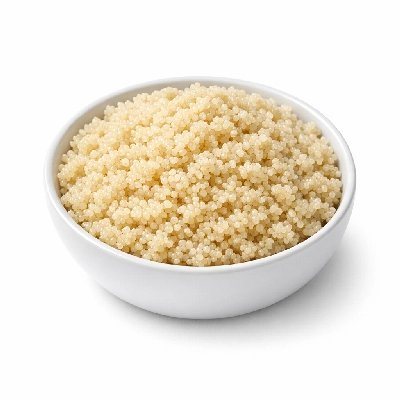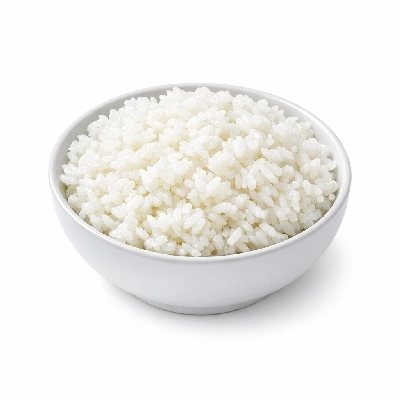
Chinese White Rice, Steamed, Restaurant
Source of Calories
Nutrition Facts
| Nutrient | Amount | % Daily Value |
|---|---|---|
| Total Carbohydrates | 44.72 g | 16% |
| Net Carbohydrates | 43.53 g | 18% |
| Sugars | No data | - |
| Added Sugars | No data | - |
| Dietary Fiber | 1.19 g | 4% |
| Protein | 4.22 g | 8% |
| Total Fat | 0.36 g | 0% |
| Saturated Fat | No data | - |
| Monounsaturated Fat | No data | - |
| Polyunsaturated Fat | No data | - |
| Trans Fat | No data | - |
| Cholesterol | No data | - |
| Vitamins | ||
| Vitamin A | No data | - |
| Vitamin C | No data | - |
| Vitamin D | No data | - |
| Minerals | ||
| Sodium | 6.6 mg | 0% |
| Potassium | 26.4 mg | 1% |
| Calcium | 6.6 mg | 1% |
| Magnesium | 6.6 mg | 2% |
| Iron | 0.51 mg | 3% |
| Zinc | 0.9 mg | 8% |
% DV refers to how much a single serving of an individually packaged food or supplement contributes nutritionally to your daily diet, based on a 2,000-calorie-a-day diet. Generally, having 5% DV or less of a nutrient per serving is considered low, and 20% DV or more of a nutrient per serving is considered high.
Vitamin Coverage
Vitamin A
-
Vitamin C
-
Vitamin D
-
Vitamin E
-
Vitamin K
-
Vitamin B1
2%
Vitamin B2
2%
Vitamin B3
5%
Vitamin B5
-
Vitamin B6
2%
Vitamin B7
-
Vitamin B9
2%
Vitamin B12
-
There are 13 essential vitamins required for the body to work properly, which are categorised into two categories: fat-soluble and water-soluble vitamins. Vitamins have a Recommended Dietary Allowance (RDA), provided by the Dietary Reference Intakes (DRIs), which vary by age and sex. The %DV indicates how much one serving contributes to the average recommended daily intake.
Mineral Coverage
Calcium
0.5%
Iron
3%
Magnesium
2%
Phosphorus
3%
Potassium
0.6%
Sodium
0.3%
Zinc
8%
Copper
7%
Manganese
26%
Selenium
-
Minerals are micronutrients, of which 13 of them are essential to the human body. The Recommended Dietary Allowance includes Calcium (1,300 mg/d), Phosphorus (1,250 mg/d), Potassium (4,700 mg/d), Sodium (2,300 mg/d), Chloride (1,500 mg/d), Magnesium (420 mg/d), Iron (18 mg/d), Zinc (11 mg/d), Copper (0.9 mg/d), Selenium (55 mcg/d), Molybdenum (45 mcg/d), Manganese (2.3 mg/d) and Iodine (150 mcg/d).
The data provided by eato.health is for informational purposes only and should not be considered medical advice. Please consult your physician before beginning any diet or nutrition plan.
About
How Long to Burn Off 199 Calories?
*Based on this person: 25-year-old female, 5'7", 144 lbs

Swimming
30 min

Jogging
26 min

Cycling
26 min

Walking
47 min
The data provided by eato.health is for informational purposes only and should not be considered medical advice. Please consult your physician before beginning any diet or nutrition plan.
📚 Health Research & Evidence About This Food
Higher consumption of white rice is significantly associated with an increased risk of type 2 diabetes, particularly in Asian populations, according to a meta-analysis of prospective cohort studies. This meta-analysis, which included a substantial number of participants and incident cases of type 2 diabetes, found this association to be more pronounced in Asian populations compared to Western populations. As a high-carbohydrate food, white rice can significantly impact blood sugar levels, with its glycemic index and carbohydrate digestibility not substantially reduced by cooling or genetic variations in starch-digesting enzymes, as shown in a randomized crossover trial. Healthline also notes that cooked short-grain white rice is enriched with folate, selenium, pantothenic acid, and iron.
1. Diabetic Diet
Source: MedlinePlus
Summary: White rice is identified as a high-carb food that can significantly impact blood sugar levels, making dietary choices crucial for managing diabetes.
Read More: https://medlineplus.gov/diabeticdiet.html
2. White Rice Consumption and Risk of Type 2 Diabetes: Meta-Analysis and Systematic Review.
Source: PubMed
Summary: Higher consumption of white rice is significantly associated with an increased risk of type 2 diabetes, particularly in Asian populations.
Read More: https://pubmed.ncbi.nlm.nih.gov/22422870/
3. Carbs in Rice: Is It Too Much?
Source: Healthline, 2017
Summary: One cup of cooked short-grain white rice contains total carbohydrates and is enriched with the daily value for folate, selenium, pantothenic acid, and iron.
4. Neither Low Salivary Amylase Activity, Cooling Cooked White Rice, nor Single Nucleotide Polymorphisms in Starch-Digesting Enzymes Reduce Glycemic Index or Starch Digestibility: A Randomized, Crossover Trial in Healthy Adults.
Source: PubMed
Summary: Neither cooling cooked white rice nor common genetic variations in starch-digesting enzymes significantly reduce the glycemic index or in vivo carbohydrate digestibility of cooked polished rice.
Read More: https://pubmed.ncbi.nlm.nih.gov/34293081/