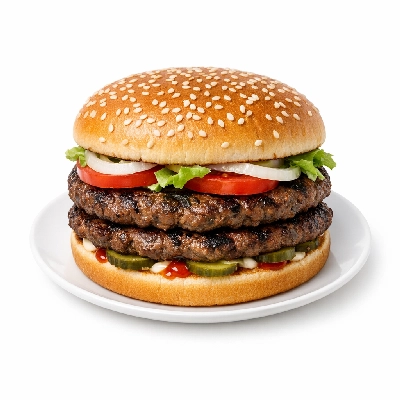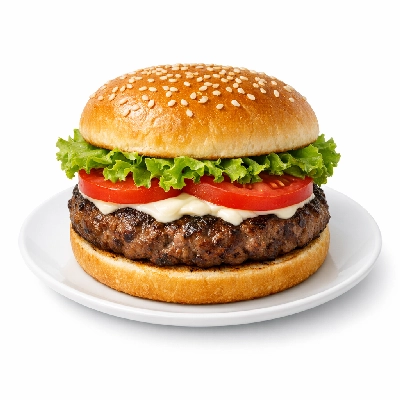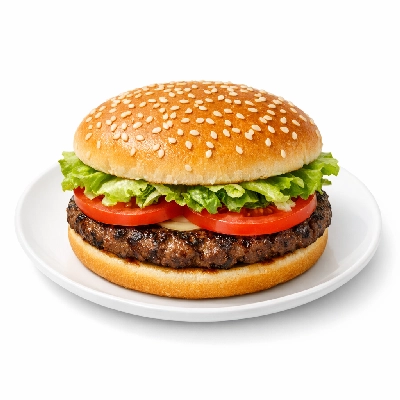
Burger King, Whopper without Cheese
Source of Calories
Nutrition Facts
| Nutrient | Amount | % Daily Value |
|---|---|---|
| Total Carbohydrates | 53.98 g | 20% |
| Net Carbohydrates | 48.74 g | 20% |
| Sugars | 12.28 g | 35% |
| Added Sugars | No data | - |
| Dietary Fiber | 5.24 g | 19% |
| Protein | 31.25 g | 63% |
| Total Fat | 37.36 g | 48% |
| Saturated Fat | 12.37 g | 62% |
| Monounsaturated Fat | 13.63 g | - |
| Polyunsaturated Fat | 9.86 g | - |
| Trans Fat | No data | - |
| Cholesterol | 87.3 mg | 29% |
| Vitamins | ||
| Vitamin A | No data | - |
| Vitamin C | 0.58 mg | 1% |
| Vitamin D | No data | - |
| Minerals | ||
| Sodium | 910.83 mg | 40% |
| Potassium | 491.79 mg | 10% |
| Calcium | 113.49 mg | 9% |
| Magnesium | 52.38 mg | 12% |
| Iron | 12.72 mg | 71% |
| Zinc | 8.24 mg | 75% |
% DV refers to how much a single serving of an individually packaged food or supplement contributes nutritionally to your daily diet, based on a 2,000-calorie-a-day diet. Generally, having 5% DV or less of a nutrient per serving is considered low, and 20% DV or more of a nutrient per serving is considered high.
Fat Composition
The suggested total fat consumption should be limited to 30% of total energy intake or less. The type of fat consumed should primarily be unsaturated fatty acids, with no more than 10% of total energy intake coming from saturated fatty acids (about 200 calories on a 2000-calorie diet) and no more than 1% of total energy intake coming from trans-fatty acids.
Vitamin Coverage
Vitamin A
-
Vitamin C
0.6%
Vitamin D
-
Vitamin E
3%
Vitamin K
47%
Vitamin B1
52%
Vitamin B2
39%
Vitamin B3
52%
Vitamin B5
10%
Vitamin B6
16%
Vitamin B7
-
Vitamin B9
51%
Vitamin B12
-
There are 13 essential vitamins required for the body to work properly, which are categorised into two categories: fat-soluble and water-soluble vitamins. Vitamins have a Recommended Dietary Allowance (RDA), provided by the Dietary Reference Intakes (DRIs), which vary by age and sex. The %DV indicates how much one serving contributes to the average recommended daily intake.
Mineral Coverage
Calcium
9%
Iron
71%
Magnesium
12%
Phosphorus
21%
Potassium
10%
Sodium
40%
Zinc
75%
Copper
4%
Manganese
23%
Selenium
96%
Minerals are micronutrients, of which 13 of them are essential to the human body. The Recommended Dietary Allowance includes Calcium (1,300 mg/d), Phosphorus (1,250 mg/d), Potassium (4,700 mg/d), Sodium (2,300 mg/d), Chloride (1,500 mg/d), Magnesium (420 mg/d), Iron (18 mg/d), Zinc (11 mg/d), Copper (0.9 mg/d), Selenium (55 mcg/d), Molybdenum (45 mcg/d), Manganese (2.3 mg/d) and Iodine (150 mcg/d).
Protein Quality
Leucine
75%
Isoleucine
75%
Valine
72%
Lysine
65%
Tryptophan
58%
Threonine
78%
Phenylalanine
116%
Methionine
91%
Histidine
75%
Guidelines recommend a serving of protein with each meal and 1.2-1.6 g of protein per kg of body weight per day.
The data provided by eato.health is for informational purposes only and should not be considered medical advice. Please consult your physician before beginning any diet or nutrition plan.
About
How Long to Burn Off 678 Calories?
*Based on this person: 25-year-old female, 5'7", 144 lbs

Swimming
1 h 40 min

Jogging
1 h 26 min

Cycling
1 h 28 min

Walking
2 h 40 min
The data provided by eato.health is for informational purposes only and should not be considered medical advice. Please consult your physician before beginning any diet or nutrition plan.
📚 Health Research & Evidence About This Food
The Whopper, like other fast-food items, contains saturated fat, which MedlinePlus identifies as an unhealthy dietary fat and a significant risk factor for heart disease when consumed in excess. Its beef patty, similar to other hamburgers as a category of processed meat products, has been found to exhibit high saturated and trans fatty acid content in studies evaluating such products, with some showing high levels of saturated fatty acids and trans fatty acids like elaidic acid/vaccenic acid. Burgers generally provide more calories and total fat compared to alternative options. However, beef patties, such as those used in a Whopper, have been shown in randomized controlled trials to effectively stimulate muscle and whole-body protein synthesis, demonstrating a greater increase in muscle protein fractional synthetic rate compared to a soy-based meat alternative.
1. Facts About Saturated Fats: Medlineplus Medical Encyclopedia
Source: MedlinePlus
Summary: The Whopper contains saturated fat, which MedlinePlus identifies as an unhealthy dietary fat that is typically solid at room temperature and a significant risk factor for heart disease when consumed in excess.
Read More: https://medlineplus.gov/ency/patientinstructions/000838.htm
2. Comprehensive Assessment of Fatty Acid Profiles of Meat Products to Develop Action Plan Strategies for Healthier Products
Source: Nature, 2025
Summary: Hamburgers exhibited the highest saturated fatty acid content and high trans fatty acid levels, primarily elaidic acid/vaccenic acid, suggesting the use of hydrogenated oils.
Read More: https://www.nature.com/articles/s41598-025-04749-z
3. Examination of the Nutritional Composition of Alternative Beef Burgers Available in the United States
Source: Taylor & Francis
Summary: Beef burgers consistently provide more calories, total fat, saturated fat, trans fat, and cholesterol compared to both imitation and veggie burgers, while also containing more protein but lower levels of sodium and fiber.
Read More: https://www.tandfonline.com/doi/full/10.1080/09637486.2021.2010035
4. The Anabolic Response to a Ground Beef Patty and Soy-Based Meat Alternative: A Randomized Controlled Trial.
Source: PubMed
Summary: A beef patty stimulates muscle and whole-body protein synthesis more effectively than a soy-based meat alternative patty, achieving a similar anabolic effect to a soy-based meat alternative portion.
Read More: https://pubmed.ncbi.nlm.nih.gov/39222687/