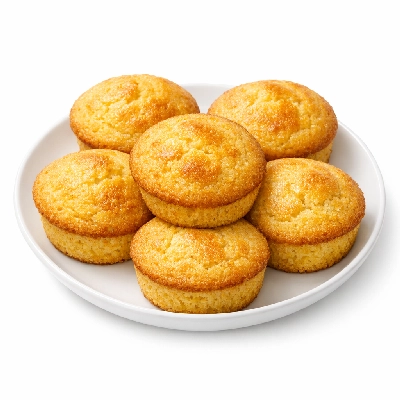
Plain Muffins, Homemade
Source of Calories
Nutrition Facts
| Nutrient | Amount | % Daily Value |
|---|---|---|
| Total Carbohydrates | 11.74 g | 4% |
| Net Carbohydrates | 10.97 g | 4% |
| Sugars | No data | - |
| Added Sugars | No data | - |
| Dietary Fiber | 0.77 g | 3% |
| Protein | 1.96 g | 4% |
| Total Fat | 3.23 g | 4% |
| Saturated Fat | 0.61 g | 3% |
| Monounsaturated Fat | 0.78 g | - |
| Polyunsaturated Fat | 1.62 g | - |
| Trans Fat | No data | - |
| Cholesterol | 11.06 mg | 4% |
| Vitamins | ||
| Vitamin A | 11.06 mcg | 1% |
| Vitamin C | 0.09 mg | 0% |
| Vitamin D | No data | - |
| Minerals | ||
| Sodium | 132.39 mg | 6% |
| Potassium | 34.3 mg | 1% |
| Calcium | 56.7 mg | 4% |
| Magnesium | 4.82 mg | 1% |
| Iron | 0.68 mg | 4% |
| Zinc | 0.16 mg | 1% |
% DV refers to how much a single serving of an individually packaged food or supplement contributes nutritionally to your daily diet, based on a 2,000-calorie-a-day diet. Generally, having 5% DV or less of a nutrient per serving is considered low, and 20% DV or more of a nutrient per serving is considered high.
Fat Composition
The suggested total fat consumption should be limited to 30% of total energy intake or less. The type of fat consumed should primarily be unsaturated fatty acids, with no more than 10% of total energy intake coming from saturated fatty acids (about 200 calories on a 2000-calorie diet) and no more than 1% of total energy intake coming from trans-fatty acids.
Vitamin Coverage
Vitamin A
1%
Vitamin C
0.1%
Vitamin D
-
Vitamin E
-
Vitamin K
-
Vitamin B1
7%
Vitamin B2
7%
Vitamin B3
4%
Vitamin B5
2%
Vitamin B6
0.7%
Vitamin B7
-
Vitamin B9
6%
Vitamin B12
2%
There are 13 essential vitamins required for the body to work properly, which are categorised into two categories: fat-soluble and water-soluble vitamins. Vitamins have a Recommended Dietary Allowance (RDA), provided by the Dietary Reference Intakes (DRIs), which vary by age and sex. The %DV indicates how much one serving contributes to the average recommended daily intake.
Mineral Coverage
Calcium
4%
Iron
4%
Magnesium
1%
Phosphorus
3%
Potassium
0.7%
Sodium
6%
Zinc
1%
Copper
2%
Manganese
4%
Selenium
9%
Minerals are micronutrients, of which 13 of them are essential to the human body. The Recommended Dietary Allowance includes Calcium (1,300 mg/d), Phosphorus (1,250 mg/d), Potassium (4,700 mg/d), Sodium (2,300 mg/d), Chloride (1,500 mg/d), Magnesium (420 mg/d), Iron (18 mg/d), Zinc (11 mg/d), Copper (0.9 mg/d), Selenium (55 mcg/d), Molybdenum (45 mcg/d), Manganese (2.3 mg/d) and Iodine (150 mcg/d).
Protein Quality
Leucine
5%
Isoleucine
6%
Valine
6%
Lysine
3%
Tryptophan
7%
Threonine
5%
Phenylalanine
8%
Methionine
6%
Histidine
5%
Guidelines recommend a serving of protein with each meal and 1.2-1.6 g of protein per kg of body weight per day.
The data provided by eato.health is for informational purposes only and should not be considered medical advice. Please consult your physician before beginning any diet or nutrition plan.
About
How Long to Burn Off 84 Calories?
*Based on this person: 25-year-old female, 5'7", 144 lbs

Swimming
13 min

Jogging
11 min

Cycling
11 min

Walking
20 min
The data provided by eato.health is for informational purposes only and should not be considered medical advice. Please consult your physician before beginning any diet or nutrition plan.
📚 Health Research & Evidence About This Food
Muffins, like other common desserts, are typically high in carbohydrates and sugar, which can significantly impact blood sugar levels for individuals with diabetes, according to the CDC, due to the presence of sugar, flour, and dairy. However, research demonstrates that muffins can be nutritionally enhanced by incorporating ingredients like sour cherry pomace, extruded sunflower seed kernel flour, or banana peel powder, leading to improved satiety, lower glucose responses in healthy individuals, increased fiber and protein, and reduced fat and sugar content.
1. Can People With Diabetes Have Dessert?
Source: CDC, 2024
Summary: Sweets, including many common desserts like muffins, are typically high in carbohydrates from sugar, flour, and dairy, which can significantly impact blood sugar levels for individuals with diabetes.
Read More: https://www.cdc.gov/diabetes/healthy-eating/people-with-diabetes-dessert.html
2. The Effects of Muffins Enriched With Sour Cherry Pomace on Acceptability, Glycemic Response, Satiety and Energy Intake: A Randomized Crossover Trial.
Source: PubMed
Summary: Muffins enriched with sour cherry pomace led to lower glucose responses, improved satiety, and reduced subsequent energy intake in healthy individuals.
Read More: https://pubmed.ncbi.nlm.nih.gov/26250501/
3. Effect of Partial Replacement of Wheat Flour by Flour From Extruded Sunflower Seed Kernels on Muffins Quality.
Source: PubMed
Summary: Muffins with extruded sunflower seed kernel flour showed the best sensory results, including a pleasant nutty and sunflower aroma, and significantly improved nutritional profiles with increased protein, fat, fiber, and ash content, alongside decreased carbohydrates and sugars.
Read More: https://pubmed.ncbi.nlm.nih.gov/39222224/
4. Development of Fiber-Enriched Muffins Using Pomegranate Peel Powder and Its Effect on Physico-Chemical Properties and Shelf Life of the Muffins.
Source: PubMed
Summary: Muffins with pomegranate peel powder (PPP) substitution showed improved oxidative and microbial stability, acting as a natural preservative.
Read More: https://pubmed.ncbi.nlm.nih.gov/37975745/
5. Enhancing the Dietary Fibre in Muffins With Banana Peel Powder and Evaluating Its Effect on Physicochemical Characteristics, Textural Quality and Storage Life
Source: SpringerLink
Summary: Muffins with a replacement of refined wheat flour with banana peel powder showed improved sensory appeal and nutritional benefits, including reduced fat, lower gluten, and enhanced dietary fiber.
Read More: https://link.springer.com/article/10.1007/s44187-025-00544-x