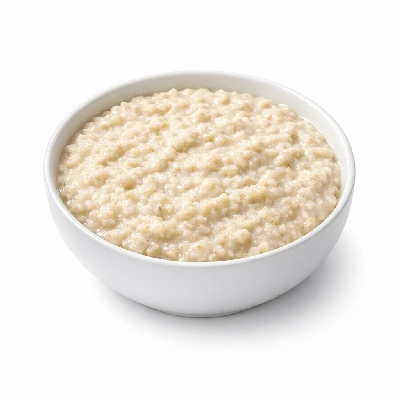
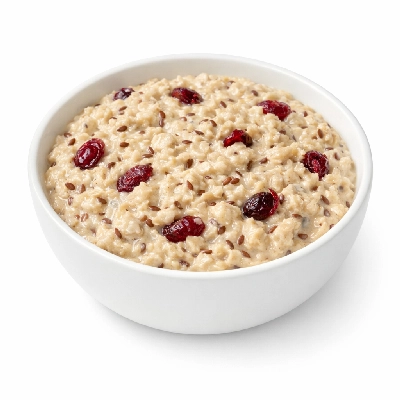
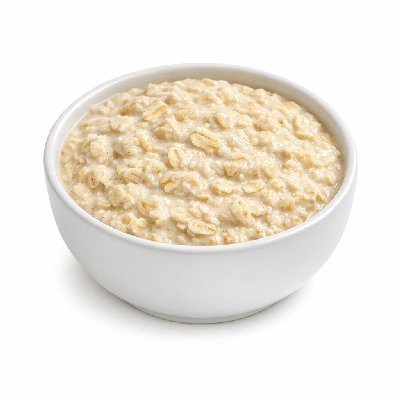
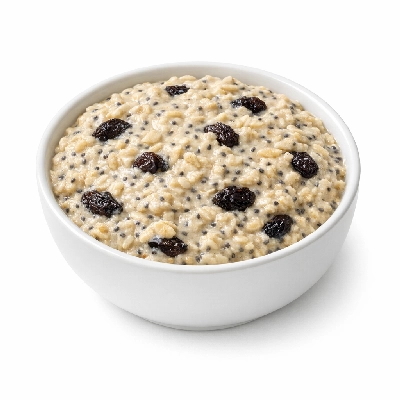
Overnight Oats & Raspberries
Source of Calories
Nutrition Facts
| Nutrient | Amount | % Daily Value |
|---|---|---|
| Total Carbohydrates | 68.28 g | 25% |
| Net Carbohydrates | 51.65 g | 21% |
| Sugars | 26.11 g | 75% |
| Added Sugars | 5.81 g | 12% |
| Dietary Fiber | 16.64 g | 59% |
| Protein | 14.59 g | 29% |
| Total Fat | 8.73 g | 11% |
| Saturated Fat | 1.96 g | 10% |
| Monounsaturated Fat | 1.61 g | - |
| Polyunsaturated Fat | 4.29 g | - |
| Trans Fat | 0.08 g | 100% |
| Cholesterol | 8.13 mg | 3% |
| Vitamins | ||
| Vitamin A | 96.93 mcg | 11% |
| Vitamin C | 32.66 mg | 36% |
| Vitamin D | 1.95 mcg | 10% |
| Minerals | ||
| Sodium | 79.79 mg | 3% |
| Potassium | 696.28 mg | 15% |
| Calcium | 336.91 mg | 26% |
| Magnesium | 151.05 mg | 36% |
| Iron | 4.78 mg | 27% |
| Zinc | 3.27 mg | 30% |
% DV refers to how much a single serving of an individually packaged food or supplement contributes nutritionally to your daily diet, based on a 2,000-calorie-a-day diet. Generally, having 5% DV or less of a nutrient per serving is considered low, and 20% DV or more of a nutrient per serving is considered high.
Fat Composition
The suggested total fat consumption should be limited to 30% of total energy intake or less. The type of fat consumed should primarily be unsaturated fatty acids, with no more than 10% of total energy intake coming from saturated fatty acids (about 200 calories on a 2000-calorie diet) and no more than 1% of total energy intake coming from trans-fatty acids.
Vitamin Coverage
Vitamin A
11%
Vitamin C
36%
Vitamin D
10%
Vitamin E
9%
Vitamin K
80%
Vitamin B1
24%
Vitamin B2
33%
Vitamin B3
13%
Vitamin B5
31%
Vitamin B6
21%
Vitamin B7
44%
Vitamin B9
13%
Vitamin B12
32%
There are 13 essential vitamins required for the body to work properly, which are categorised into two categories: fat-soluble and water-soluble vitamins. Vitamins have a Recommended Dietary Allowance (RDA), provided by the Dietary Reference Intakes (DRIs), which vary by age and sex. The %DV indicates how much one serving contributes to the average recommended daily intake.
Mineral Coverage
Calcium
26%
Iron
27%
Magnesium
36%
Phosphorus
37%
Potassium
15%
Sodium
3%
Zinc
30%
Copper
47%
Manganese
116%
Selenium
44%
Minerals are micronutrients, of which 13 of them are essential to the human body. The Recommended Dietary Allowance includes Calcium (1,300 mg/d), Phosphorus (1,250 mg/d), Potassium (4,700 mg/d), Sodium (2,300 mg/d), Chloride (1,500 mg/d), Magnesium (420 mg/d), Iron (18 mg/d), Zinc (11 mg/d), Copper (0.9 mg/d), Selenium (55 mcg/d), Molybdenum (45 mcg/d), Manganese (2.3 mg/d) and Iodine (150 mcg/d).
Protein Quality
Leucine
38%
Isoleucine
45%
Valine
47%
Lysine
32%
Tryptophan
61%
Threonine
38%
Phenylalanine
60%
Methionine
46%
Histidine
37%
Guidelines recommend a serving of protein with each meal and 1.2-1.6 g of protein per kg of body weight per day.
The data provided by eato.health is for informational purposes only and should not be considered medical advice. Please consult your physician before beginning any diet or nutrition plan.
About
How Long to Burn Off 393 Calories?
*Based on this person: 25-year-old female, 5'7", 144 lbs

Swimming
58 min

Jogging
50 min

Cycling
51 min

Walking
1 h 33 min
The data provided by eato.health is for informational purposes only and should not be considered medical advice. Please consult your physician before beginning any diet or nutrition plan.
📚 Health Research & Evidence About This Food
Overnight Oats are a fiber-rich food that supports gut health and helps regulate blood sugar. The beta-glucan soluble fiber in oats promotes regular bowel movements and prevents constipation, while oats' resistant starch, which can be increased by a "cook-and-cool" technique, nourishes beneficial gut microorganisms and can improve blood sugar control by slowing its rise after meals. If prepared with red raspberries, Overnight Oats also provide essential vitamins, minerals, antioxidants like ellagitannins and anthocyanins, and additional fiber, which may further support metabolic health by mitigating metabolic, oxidative, and inflammatory links.
1. Raspberries: Health Benefits, Nutrients per Serving, Preparation Information, and More
Source: WebMD
Summary: Raspberries are packed with essential vitamins, minerals, antioxidants, and fiber, offering significant health benefits, particularly in diabetes management due to their high fiber content and low sugar.
Read More: https://www.webmd.com/diet/health-benefits-raspberries
2. Oatmeal: Health Benefits, Nutrients per Serving, Preparation Information, and More
Source: WebMD
Summary: Oatmeal promotes gut health through beta-glucan soluble fiber, which aids regular bowel movements and prevents constipation.
Read More: https://www.webmd.com/diet/health-benefits-oatmeal
3. Resistant Starch: Can You Make the Carbs You Eat a Little Healthier? - Harvard Health
Source: Harvard Health, 2026
Summary: Oats provide resistant starch, which nourishes beneficial gut microorganisms and can improve blood sugar control.
4. Choosing Healthy Carbs
Source: CDC, 2024
Summary: Old-fashioned or steel-cut oats are a superior whole grain alternative to sugary cereals, providing complex carbohydrates rich in fiber that are digested slowly and lead to a more gradual increase in blood sugar.
Read More: https://www.cdc.gov/diabetes/healthy-eating/choosing-healthy-carbs.html
5. Red Raspberries and Their Bioactive Polyphenols: Cardiometabolic and Neuronal Health Links.
Source: PubMed
Summary: Red raspberries hold promise in modulating metabolic disease risk due to their rich nutrient and bioactive composition, including essential micronutrients, dietary fibers, and polyphenols.
Read More: https://pubmed.ncbi.nlm.nih.gov/26773014/
6. 12 Foods That Help Reduce Bloating
Source: Cleveland Clinic
Summary: Overnight Oats provide significant constipation-fighting fiber, comparable to quinoa.
Read More: https://health.clevelandclinic.org/foods-that-help-with-bloating