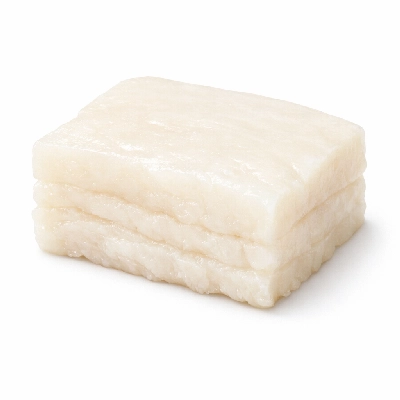
Alaska Native Whale Bowhead Muktuk, Skin and Subcutaneous Fat
Source of Calories
Nutrition Facts
| Nutrient | Amount | % Daily Value |
|---|---|---|
| Total Carbohydrates | 0 g | 0% |
| Net Carbohydrates | 0 g | 0% |
| Sugars | No data | - |
| Added Sugars | No data | - |
| Dietary Fiber | No data | - |
| Protein | 12.6 g | 25% |
| Total Fat | 46.1 g | 59% |
| Saturated Fat | 6.56 g | 33% |
| Monounsaturated Fat | 28.12 g | - |
| Polyunsaturated Fat | 7.97 g | - |
| Trans Fat | No data | - |
| Cholesterol | 54 mg | 18% |
| Vitamins | ||
| Vitamin A | 225 mcg | 25% |
| Vitamin C | No data | - |
| Vitamin D | No data | - |
| Minerals | ||
| Sodium | No data | - |
| Potassium | No data | - |
| Calcium | 5 mg | 0% |
| Magnesium | No data | - |
| Iron | No data | - |
| Zinc | No data | - |
% DV refers to how much a single serving of an individually packaged food or supplement contributes nutritionally to your daily diet, based on a 2,000-calorie-a-day diet. Generally, having 5% DV or less of a nutrient per serving is considered low, and 20% DV or more of a nutrient per serving is considered high.
Fat Composition
The suggested total fat consumption should be limited to 30% of total energy intake or less. The type of fat consumed should primarily be unsaturated fatty acids, with no more than 10% of total energy intake coming from saturated fatty acids (about 200 calories on a 2000-calorie diet) and no more than 1% of total energy intake coming from trans-fatty acids.
Vitamin Coverage
Vitamin A
25%
Vitamin C
-
Vitamin D
-
Vitamin E
-
Vitamin K
-
Vitamin B1
7%
Vitamin B2
2%
Vitamin B3
5%
Vitamin B5
-
Vitamin B6
-
Vitamin B7
-
Vitamin B9
-
Vitamin B12
-
There are 13 essential vitamins required for the body to work properly, which are categorised into two categories: fat-soluble and water-soluble vitamins. Vitamins have a Recommended Dietary Allowance (RDA), provided by the Dietary Reference Intakes (DRIs), which vary by age and sex. The %DV indicates how much one serving contributes to the average recommended daily intake.
Mineral Coverage
Calcium
0.4%
Iron
-
Magnesium
-
Phosphorus
7%
Potassium
-
Sodium
-
Zinc
-
Copper
-
Manganese
-
Selenium
-
Minerals are micronutrients, of which 13 of them are essential to the human body. The Recommended Dietary Allowance includes Calcium (1,300 mg/d), Phosphorus (1,250 mg/d), Potassium (4,700 mg/d), Sodium (2,300 mg/d), Chloride (1,500 mg/d), Magnesium (420 mg/d), Iron (18 mg/d), Zinc (11 mg/d), Copper (0.9 mg/d), Selenium (55 mcg/d), Molybdenum (45 mcg/d), Manganese (2.3 mg/d) and Iodine (150 mcg/d).
The data provided by eato.health is for informational purposes only and should not be considered medical advice. Please consult your physician before beginning any diet or nutrition plan.
About
How Long to Burn Off 465 Calories?
*Based on this person: 25-year-old female, 5'7", 144 lbs

Swimming
1 h 9 min

Jogging
59 min

Cycling
1 h 1 min

Walking
1 h 50 min
The data provided by eato.health is for informational purposes only and should not be considered medical advice. Please consult your physician before beginning any diet or nutrition plan.
📚 Health Research & Evidence About This Food
Muktuk, a traditional food made from whale skin and subcutaneous fat, is a marine mammal product that, like other marine foods, has been studied for mercury exposure, with mercury levels showing a strong correlation with dietary intake in studies of adult Greenland Inuit. It can also carry risks of IgE-mediated food allergies, as observed in cases of anaphylaxis to bowhead whale, or parasitic infections such as trichinellosis from *Trichinella* species acquired from marine mammals like walrus and seals. Like other marine mammal products, muktuk may contain very long chain omega-3 fatty acids, including eicosapentaenoic acid (EPA) and docosahexaenoic acid (DHA), which are critical for supporting human health and optimizing cell and tissue responsiveness by influencing cell membrane structure, protein function, and gene expression.
1. Seal and Whale Meat: Two Newly Recognized Food Allergies.
Source: PubMed
Summary: Bowhead whale and bearded seal meat can cause IgE-mediated food allergies, as evidenced by a case of moderate anaphylaxis in an Inupiaq boy who showed specific IgE binding to protein bands in extracts of both meats.
Read More: https://pubmed.ncbi.nlm.nih.gov/17225727/
2. Assessment of Consumption of Marine Food in Greenland by a Food Frequency Questionnaire and Biomarkers.
Source: Taylor & Francis
Summary: Muktuk is made from the skin and subcutaneous fat of whales, and a study of adult Greenland Inuit found that self-reported marine food consumption correlated with mercury levels.
Read More: https://www.tandfonline.com/doi/full/10.3402/ijch.v71i0.18361
3. Waterborne Parasitic Diseases in Ocean
Source: SpringerLink
Summary: Trichinella species, particularly *T. spiralis* and *T. nativa*, are acquired from marine mammals such as walrus and seals, causing trichinellosis.
Read More: https://link.springer.com/rwe/10.1007/978-1-4419-0851-3_877
4. Very Long Chain Omega‐3 (N‐3) Fatty Acids and Human Health
Source: Wiley Online Library
Summary: Muktuk is a traditional food made from the skin and subcutaneous fat of whales, which are rich sources of very long chain omega-3 fatty acids, and these fatty acids play a critical role in supporting human health and well-being across the lifespan by optimizing cell and tissue responsiveness.
Read More: https://onlinelibrary.wiley.com/doi/10.1002/ejlt.201400025
5. Improving Mercury Exposure Estimates: A Meta-Analysis of Methylmercury-To-Total Mercury Ratios in Canadian Traditional Foods
Source: Nature, 2026
Summary: Muktuk is made from the skin and subcutaneous fat of whales, and a meta-analysis of mercury levels in traditional Canadian Indigenous foods found that internal organs like liver and kidney consistently showed much lower methylmercury proportions compared to muscle and egg tissues across various species.
Read More: https://www.nature.com/articles/s41370-026-00888-1