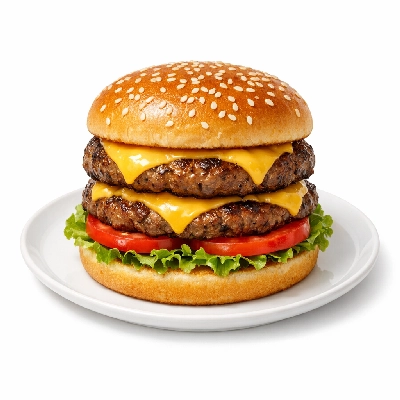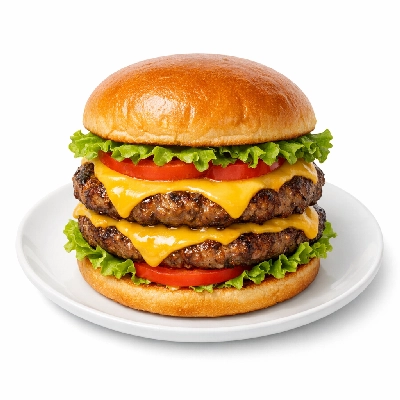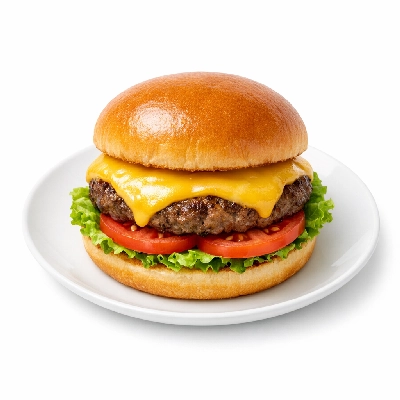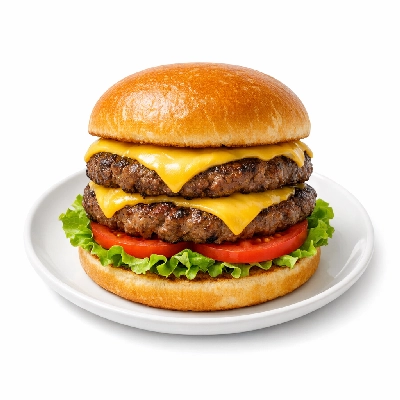
Cheeseburger, Double Patty, Double Bun with Condiments and Vegetables
Source of Calories
Nutrition Facts
| Nutrient | Amount | % Daily Value |
|---|---|---|
| Total Carbohydrates | 53.12 g | 19% |
| Net Carbohydrates | 53.12 g | 22% |
| Sugars | No data | - |
| Added Sugars | No data | - |
| Dietary Fiber | No data | - |
| Protein | 29.73 g | 59% |
| Total Fat | 35.27 g | 45% |
| Saturated Fat | 12.77 g | 64% |
| Monounsaturated Fat | 12.64 g | - |
| Polyunsaturated Fat | 6.37 g | - |
| Trans Fat | No data | - |
| Cholesterol | 93.48 mg | 31% |
| Vitamins | ||
| Vitamin A | 111.49 mcg | 12% |
| Vitamin C | 2.74 mg | 3% |
| Vitamin D | No data | - |
| Minerals | ||
| Sodium | 921.12 mg | 40% |
| Potassium | 389.88 mg | 8% |
| Calcium | 168.72 mg | 13% |
| Magnesium | 36.48 mg | 9% |
| Iron | 4.72 mg | 26% |
| Zinc | 4.13 mg | 38% |
% DV refers to how much a single serving of an individually packaged food or supplement contributes nutritionally to your daily diet, based on a 2,000-calorie-a-day diet. Generally, having 5% DV or less of a nutrient per serving is considered low, and 20% DV or more of a nutrient per serving is considered high.
Fat Composition
The suggested total fat consumption should be limited to 30% of total energy intake or less. The type of fat consumed should primarily be unsaturated fatty acids, with no more than 10% of total energy intake coming from saturated fatty acids (about 200 calories on a 2000-calorie diet) and no more than 1% of total energy intake coming from trans-fatty acids.
Vitamin Coverage
Vitamin A
12%
Vitamin C
3%
Vitamin D
-
Vitamin E
13%
Vitamin K
-
Vitamin B1
48%
Vitamin B2
33%
Vitamin B3
52%
Vitamin B5
13%
Vitamin B6
16%
Vitamin B7
-
Vitamin B9
-
Vitamin B12
86%
There are 13 essential vitamins required for the body to work properly, which are categorised into two categories: fat-soluble and water-soluble vitamins. Vitamins have a Recommended Dietary Allowance (RDA), provided by the Dietary Reference Intakes (DRIs), which vary by age and sex. The %DV indicates how much one serving contributes to the average recommended daily intake.
Mineral Coverage
Calcium
13%
Iron
26%
Magnesium
9%
Phosphorus
28%
Potassium
8%
Sodium
40%
Zinc
38%
Copper
18%
Manganese
12%
Selenium
72%
Minerals are micronutrients, of which 13 of them are essential to the human body. The Recommended Dietary Allowance includes Calcium (1,300 mg/d), Phosphorus (1,250 mg/d), Potassium (4,700 mg/d), Sodium (2,300 mg/d), Chloride (1,500 mg/d), Magnesium (420 mg/d), Iron (18 mg/d), Zinc (11 mg/d), Copper (0.9 mg/d), Selenium (55 mcg/d), Molybdenum (45 mcg/d), Manganese (2.3 mg/d) and Iodine (150 mcg/d).
The data provided by eato.health is for informational purposes only and should not be considered medical advice. Please consult your physician before beginning any diet or nutrition plan.
About
How Long to Burn Off 650 Calories?
*Based on this person: 25-year-old female, 5'7", 144 lbs

Swimming
1 h 36 min

Jogging
1 h 22 min

Cycling
1 h 25 min

Walking
2 h 33 min
The data provided by eato.health is for informational purposes only and should not be considered medical advice. Please consult your physician before beginning any diet or nutrition plan.
📚 Health Research & Evidence About This Food
A double patty cheeseburger with condiments and vegetables typically contains high levels of calories, saturated fat, and sodium, which are strongly linked to an increased risk of cardiometabolic syndrome. Excessive consumption of these components can contribute to weight gain and elevate the risk of heart disease, according to Healthline and MedlinePlus.
1. Facts About Saturated Fats: Medlineplus Medical Encyclopedia
Source: MedlinePlus
Summary: Cheeseburger weight gain is linked to the high saturated fat content found in components like cheese and red meat, which, when consumed in excess, contributes to increased caloric intake and adverse health outcomes.
Read More: https://medlineplus.gov/ency/patientinstructions/000838.htm
2. Free Statins With Fast Food Could Neutralise Heart Risk
Source: Imperial College London, 2010
Summary: Cheeseburger consumption, when combined with a milkshake, presents a cardiovascular risk that researchers suggest could be offset by taking statin drugs, which reduce unhealthy LDL cholesterol.
Read More: https://www.imperial.ac.uk/news/92085/free-statins-with-fast-food-could/
3. Impossible and Beyond: How Healthy Are These Meatless Burgers? - Harvard Health
Source: Harvard Health, 2019
Summary: Cheeseburgers are a type of traditional burger. Compared with traditional burgers, some plant-based burgers are still heavily processed and may be high in saturated fat and sodium, so they are not always a healthier choice.
4. Free Statins With Fast Food Could Neutralize Heart Risk, Scientists Say
Source: ScienceDaily, 2026
Summary: Cheeseburger consumption is linked to increased cardiovascular risk from fatty fast food, and researchers suggested that statin use might offset some of the associated heart attack risk.
Read More: https://www.sciencedaily.com/releases/2010/08/100812083608.htm
5. Temporal Trends in Fast-Food Restaurant Energy, Sodium, Saturated Fat, and Trans Fat Content, United States, 1996-2013.
Source: PubMed
Summary: Cheeseburgers were among the fast-food items analyzed in this study. Excess intakes of energy, sodium, saturated fat, and trans fat are associated with an increased risk of cardiometabolic syndrome.
Read More: https://pubmed.ncbi.nlm.nih.gov/25551184/
6. 7 Reasons to Avoid Greasy Food
Source: Healthline, 2020
Summary: Cheeseburger weight gain is a direct consequence of consuming greasy foods like cheeseburgers, which are high in calories, fat, and salt, contributing to a caloric surplus and increasing the risk of obesity, heart disease, and diabetes.