Free Calorie Calculator
Get your ideal daily protein, carbs, and fat split based on your fitness goals and diet preference.
Understanding Calorie
What Is a Calorie?
A calorie is a unit of energy. In nutrition, it tells you how much energy your body can get from the food and drinks you consumed.
Your body uses calories for basic functions like breathing, blood circulation, digestion, and maintaining body temperature. You also burn calories through daily movement and exercise.
In simple terms:
- Food and drinks provide calories.
- Your body uses calories for energy.
- Weight changes depend partly on the balance between calories in and calories out.
If you regularly eat more calories than your body uses, your weight may increase. If you regularly eat fewer calories than your body uses, your weight may decrease.
How Are Calories Calculated?
Daily calorie needs are usually estimated in two steps: first by calculating your Basal Metabolic Rate, or BMR, and then by adjusting it based on your activity level. BMR is the energy your body uses at rest for essential functions such as breathing, circulation, and cell repair.
BMR can be estimated using 3 widely recognised equations based on factors such as weight, height, age, sex, and sometimes body fat percentage. Our BMR calculator lets you choose from three formulas:
- Mifflin-St Jeor: Often used as a standard equation for the general adult population.
- Men: BMR = 10W + 6.25H - 5A + 5
- Women: BMR = 10W + 6.25H - 5A - 161
- Revised Harris-Benedict: An updated version of the classic Harris-Benedict equation.
- Men: BMR = 13.397W + 4.799H - 5.677A + 88.362
- Women: BMR = 9.247W + 3.098H - 4.330A + 447.593
- Katch-McArdle: Often used when lean body mass or body fat percentage is available.
- Formula: BMR = 370 + 21.6 × (1 - F) × W
Where W = weight in kg, H = height in cm, A = age, and F = body fat as a decimal, such as 0.20 for 20% body fat.
After BMR is estimated, it is multiplied by an activity factor based on your usual activity level. This factor usually ranges from about 1.2 to 1.9, from sedentary to very active lifestyles.
BMR × Activity Factor = Estimated Daily Calorie Needs
The final number is your estimated maintenance calories, or the calories you may need per day to keep your current weight roughly stable.
What Happens When Calories Are Too Low or Too High?
Eating too few or too many calories for a long period can affect your health and weight.
If your calorie intake is too low, you may feel tired, weak, dizzy, or have trouble concentrating. Very low intake can also make it harder to get enough protein, fiber, vitamins, and minerals. Over time, your body may adapt by using less energy.
If your calorie intake is consistently too high, your body may store the extra energy as fat. This can increase the risk of weight gain and may contribute to health problems such as high blood pressure, type 2 diabetes, and heart disease.
A balanced calorie target should support your goal while still giving your body enough nutrition and energy.
Calories Found in Common Foods
Calorie values can vary by brand, cooking method, and portion size, but the examples below can help you understand common food estimates.
| Food Item | Serving Size | Calories |
|---|---|---|
| Apple | 1 medium, 4 oz | 59 |
| Banana | 1 medium, 6 oz | 151 |
| Orange | 1 medium, 4 oz | 53 |
| Broccoli | 1 cup | 45 |
| Carrot | 1 cup | 50 |
| Tomato | 1 cup | 22 |
| Cooked chicken | 2 oz | 136 |
| Cooked fish | 4 oz | 136 |
| Cooked pork | 2 oz | 137 |
| Egg | 1 large | 78 |
| Tofu | 4 oz | 86 |
| Cooked rice | 1 cup | 206 |
| White bread | 1 oz | 75 |
| Corn | 1 cup | 132 |
Use this as a quick reference, not an exact label. For packaged foods, check the nutrition label whenever possible.
FAQ
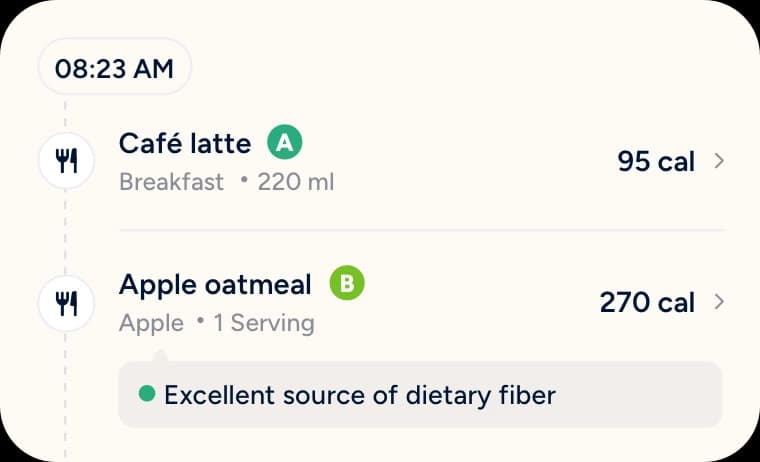
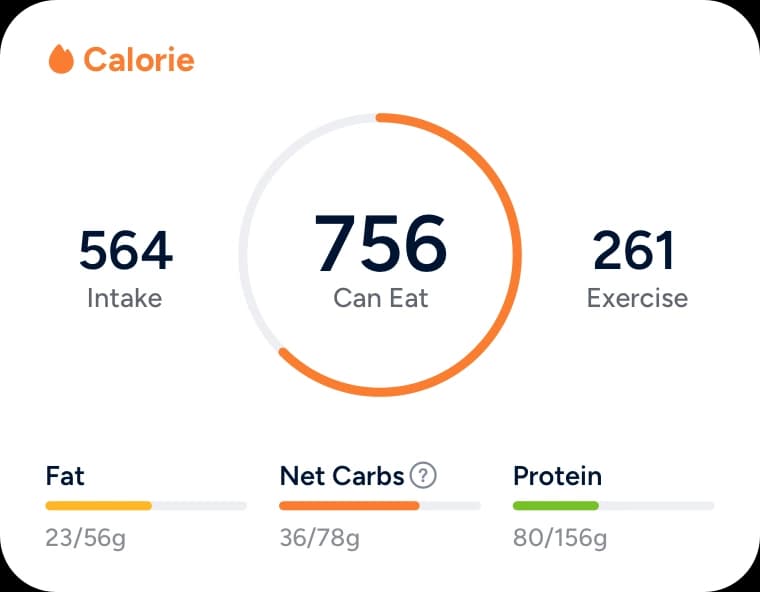

Track Calories, Macros, and Eat Smarter with Eato
Log meals, monitor calories, track macros, and build healthier eating habits with Eato’s easy-to-use calorie counter app today.